

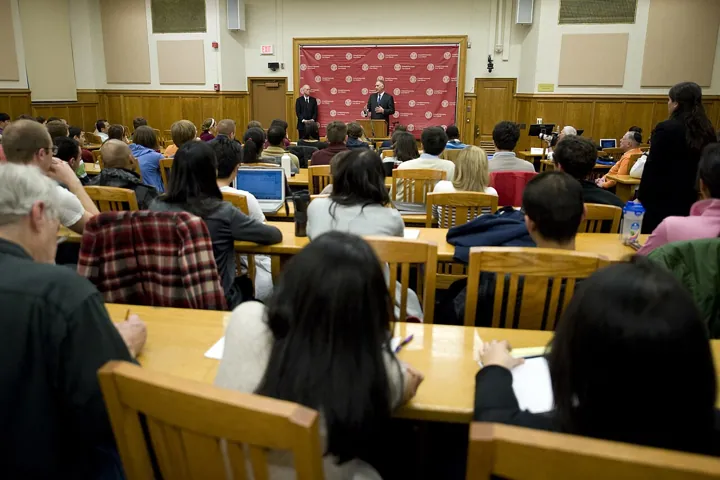
- Description
- A lecture hall
- Source
- Cherie Cullen · original page
- Licence
- PD Public domain
 The mere-exposure effect
The more we run into someone or something, the more we like it, and we mistake that familiarity for quality.
In brief
- What: mere repeated exposure to a stimulus (a person, a name, a tool, a brand) increases how much we like it.
- Why: what is familiar is processed more easily, and that ease feels pleasant and safe.
- Spotting it: we choose “the one we know”, “the one we see all the time”, without comparing it with others.
- Avoiding it: set criteria in advance, compare at least one unfamiliar option, make the work of people we rarely see visible.
Definition#
 Fictitious illustration
The mere-exposure effect is the increase in liking for a stimulus simply because we have been exposed to it repeatedly, with no other information or reward. The effect was described by the psychologist Robert Zajonc in 1968: meaningless words, Chinese ideographs or photographs of faces seen more often are rated as more pleasant than those seen rarely or never, even though the participants did not know that the frequency varied.
In organizations, it takes the form of “I know them”: the usual supplier, the tool we have always used, the colleague we see every day in meetings seem more reliable and more competent than alternatives we rarely see. The slogan “nobody ever got fired for buying IBM” is its commercial version, sometimes cited to describe buyers’ preference for the familiar, reassuring supplier.
The mechanism#
- Processing fluency. What we have already encountered is recognized and processed faster; that ease is felt as a positive impression, which the mind attributes to the object itself.
- A safety signal. Nothing bad happened in previous encounters: repetition without consequences teaches the organism that the object is harmless.
- Often without the person’s knowledge. The effect works even when the exposure is too brief to be recognized: Kunst-Wilson and Zajonc (1980) showed figures for one millisecond; participants did not recognize the ones they had already seen, but preferred them.
- A bell-shaped curve. The effect first grows, then levels off or reverses: overexposure (tiresome repetition) can trigger irritation, especially for simple stimuli and closely spaced exposures.
Moreland and Beach (1992) sent four female students to attend a large lecture course 0, 5, 10 or 15 times during the term, without ever speaking to anyone. At the end, the other students rated their photographs: the more often a woman had attended, the more likable she was judged, and the more people thought they had things in common with her, even though no exchange had taken place.
Bornstein’s meta-analysis (1989), covering more than two hundred experiments, confirms that the effect is robust. It also shows that it is stronger when the exposure is brief or cannot be recognized, and that it is not limited to visual stimuli.
Exposure raises liking, then it levels off (illustrative shape)
Loading the chart…
View the data
| Liking (illustrative) | |
|---|---|
| 0 | 1 |
| 1 | 2 |
| 2 | 2.6 |
| 5 | 3.4 |
| 10 | 3.9 |
| 25 | 4 |
| 50 | 3.5 |
Where it shows up#
In project management#
- Choosing a supplier or a tool: the vendor already in the house wins out over an alternative that looks better on paper, without any comparison taking place. It combines with status quo bias.
- Technical choices: the language or framework the team sees every day seems “safer” than another it hardly knows.
- Estimates: a task of a known type seems less risky than one we have never done, even when the real risk is comparable.
- Subcontracting and suppliers: suppliers in frequent contact with the project manager are rated higher than those who deliver quietly; visibility rewards the frequency of exchanges, not results.
- Architecture trade-offs: we reuse the solutions from last time, which “worked”, without studying those the team has never used.
In management#
- Promotions and assignments: important tasks go to the people we see most often, in person, in meetings or on the messaging tool, to the detriment of those who work remotely or discreetly.
- Remote work: visibility becomes an implicit criterion (proximity bias); on-site staff are perceived as more engaged.
- Hiring: a candidate whose name, school or former company is known is preferred to an unknown candidate.
- Circle of trust: the manager always delegates to the same two or three people, who become “safer” as they are given more tasks, while the others never get the chance to show what they can do.
- Meetings: the person who speaks often is judged more competent than the one who speaks less but to the point.
Famous cases#
Zajonc and the meaningless words 1968#
Bias involved: mere-exposure effect.
What happened. Zajonc showed students invented words (Turkish-sounding) and other stimuli, varying the number of repetitions from 0 to 25. He then asked them to estimate whether the word “has a positive meaning”. The more often a word had been seen, the more favorably it was rated, although none of the words had any meaning. The result was replicated with Chinese ideographs and photographs of faces taken from student yearbooks, then in hundreds of studies.
What this illustrates
Familiarity creates a preference without information. When a supplier or a colleague strikes you as “good”, ask yourself: “What do I know about them, apart from the fact that I see them often?”
The four students in the lecture hall 1992#
Bias involved: mere-exposure effect (visibility without interaction).
What happened. In a large university course, four women of the same age and comparable appearance attend the class 0, 5, 10 or 15 times depending on the condition, without speaking to anyone or drawing attention to themselves. At the end of the term, participants rate their photographs. The more times a woman came, the more attractive, likable and similar to themselves she was judged, although nobody knew she was taking part in the experiment.
What this illustrates
This is the mechanism of visibility at the office: being seen more often is enough to gain likability and trust. In hybrid teams, those who are less present are mechanically judged less favorably for equal work (see also similarity bias). The experiment concerns likability, not performance; it does not say that promotion depends on it, but it explains the “I know them” mechanism.
Warning signs#
- “We have always worked with them” or “everyone knows them” is the main argument for a choice.
- The same small circle gets the visible assignments, the promotions, the training.
- The candidate or supplier already known is not compared with the others on the same criteria.
- Low-visibility staff (remote, discreet, brought in as reinforcements) receive poorer evaluations, with no facts to back them up.
- Confidence in a tool or a solution drops as soon as it is changed, before any measure of quality.
- Newcomers find it hard to be taken seriously “until we know them”.
Avoidance reflexes#
- Set criteria before looking at the options. A choice of supplier, tool or person relies on a written grid, the same for all options, known or not.
- Compare at least one unfamiliar option. Not to choose it at all costs, but to test whether familiarity carries weight: if the known option wins on the grid, the choice is justified.
- Separate knowing from evaluating. “I know them” is a piece of information (risk, track record), not proof of quality. Look for facts: results, deliverables, incidents.
- Make everyone’s work visible. Regular demos, delivery boards, attributed minutes: results, more than presence, should rise to the surface.
- Spread the opportunities. Rotate visible assignments, presentations, meeting facilitation; check periodically who has not had any.
- Equip the distance. In a hybrid team, regular one-to-one check-ins and written facts offset the lower visibility.
- Have people meet before evaluating. Exposure to the candidate or supplier (an exchange, a trial, a proof of concept) dispels the novelty effect.
- Beware of overexposure too. A tool or a face seen too often ends up wearing thin: familiarity is not always an advantage.
With AI: detect, remedy, mitigate#
AI can run a grid across all the options with the same rigor, and list who has received the visible assignments from data. But it has a frequency bias of its own: it readily recommends the option most cited in its training data, that is, the most exposed one.
Detect#
- Measure the distribution of visible assignments (presentations, facilitation, key projects) among team members.
- Spot, in a decision file, arguments of the type “we know them” or “it’s our standard”.
- Compare evaluations according to degree of presence (on site, remote) at equivalent results.
Fix#
- Apply the same grid to every option, including the least familiar, with sources.
- Search for alternatives to the usual option and summarize their differences by criterion.
- Write a summary of a person’s contributions from tickets and deliveries.
Mitigate#
- Have an anonymized comparison of options prepared, without vendor or supplier names.
- Generate a rotation table for visible assignments.
- Have everyone’s work over the period summarized, regardless of how often they speak up.
Prompts to build into your routines#
1. Anonymized comparison of options. For a choice of tool, supplier or solution, before knowing “who is who”.
Here are the selection criteria, in order of importance: [criteria and weights].
Here are three options, presented without names or brands (A, B, C): [description of each option].
Evaluate each option on each criterion, citing the specific elements of the description. If information is missing, write “unknown” rather than assuming it.
Take no account of reputation, seniority or habit. Finish with the questions to ask each option to fill in the “unknowns”.
2. Who do we see, who don’t we see?. Before a promotion review or an allocation of assignments, on anonymized data.
Here is the list of this year’s visible assignments (presentations, key projects, facilitation) and the list of each team member’s contributions (tickets, deliveries): [anonymized data].
1. Calculate the distribution of visible assignments among team members and compare it with the distribution of contributions.
2. Flag the team members whose contributions are high and visibility low, and the reverse.
3. Propose a more balanced allocation for the next quarter.
State what these data do not allow us to conclude.
How to build them in#
- At the time of the choice: prompt 1 provides a blind comparison that complements (without replacing) the team’s analysis.
- Before talent reviews: prompt 2 gives a picture of visibility, to be discussed against the facts.
- Continuously: a simple record of everyone’s contributions, kept by the team, feeds these analyses.
Precautions#
- A model has a notoriety bias: it favors frequently cited options. Explicitly ask it to disregard this, and check.
- Data about people are sensitive: anonymize, use only an approved tool, and do not turn it into an automatic ranking.
- AI recommendations on tools may contain invented features or references: check in the official documentation.
Limits#
- Familiarity is not always a bias: a supplier we know has a track record, and a tool we have mastered costs less to use. The bias begins when it replaces the criteria.
- The effect is weaker when the object is perceived negatively from the start: repeated exposure to an unpleasant stimulus can strengthen disapproval.
- It is mainly demonstrated in the laboratory, with simple, neutral stimuli. Its magnitude in real decisions about promotions or supplier choice is less well measured; it is assumed more than it is measured.
- Attributing career gaps solely to the visibility effect is a hypothesis; several factors are intertwined (network, access to sponsors, similarity bias).
Sources and verification#
- Zajonc (1968), “Attitudinal effects of mere exposure”, Journal of Personality and Social Psychology, monograph supplement — the founding study.
- Bornstein (1989), “Exposure and affect: Overview and meta-analysis of research, 1968-1987”, Psychological Bulletin — the meta-analysis.
- Kunst-Wilson & Zajonc (1980), “Affective discrimination of stimuli that cannot be recognized”, Science — exposure without recognition.
- Moreland & Beach (1992), “Exposure effects in the classroom: The development of affinity among students”, Journal of Experimental Social Psychology — the four students.
- Echterhoff et al. (2024), “Cognitive Bias in Decision-Making with LLMs” — cognitive biases in language models.
