

- Description
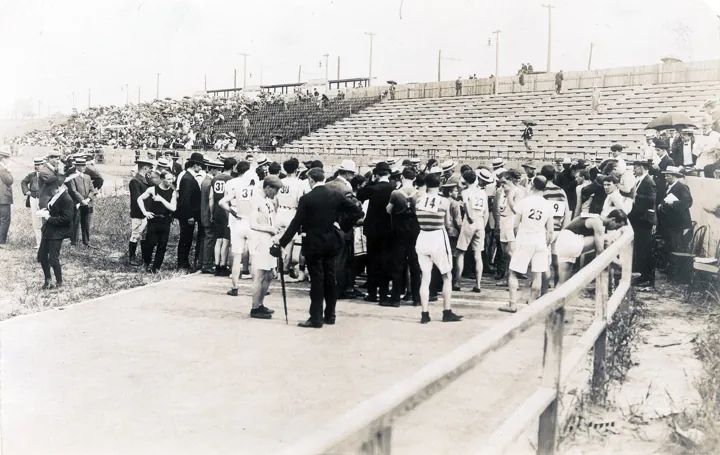
- Des coureurs en tenue d'époque, dossards sur le dos, rassemblés sur la ligne de départ d'un stade devant les tribunes.
- Source
- auteur non indiqué · original page
- Licence
- PD Public domain
 The primacy effect
The first seconds, first words, and first deliverables set an image that later facts struggle to correct.
In brief
- What: what we learn first about a person or situation weighs more than what we learn later.
- Why: the first information creates a frame; later information is read through it, or given less consideration.
- Detect: a fixed opinion after a few minutes; later facts interpreted in line with the initial impression.
- Avoid: delay the verdict, rate by criterion in writing, vary the order, give yourself an observation period.
Definition#
 Fictitious illustration
 Fictitious illustration
The primacy effect is the tendency to give more weight to the first information received than to what follows. In impression formation, it means that the first impression of a person has a lasting influence on how we judge them.
The classic demonstration is by Solomon Asch (1946): two lists of identical traits, presented in reverse order, produce two different people in participants' minds. Abraham Luchins (1957) studied the conditions under which the first or last item prevails.
The mechanism#
- An interpretive frame. The first trait provides a working hypothesis. Subsequent traits are no longer read on their own but through that lens: “intelligent” then “impulsive” is understood as “quick, spontaneous”; “impulsive” then “intelligent” as “rash despite his abilities.”
- Declining attention. We are more attentive at the beginning, then treat the impression as settled. Information that follows is processed more superficially.
- Confirmation bias. Once the hypothesis is set, we seek and retain what confirms it (see Confirmation bias). A job interview shows this clearly: an interviewer with a good impression of the file is warmer, “sells” the role more, gathers less information, and the candidate communicates better in return.
- Memory of the end of the list fades. When judgment is made after a break or another activity, the end of the list weighs less and primacy remains (see The recency effect).
Asch (1946) read two groups a list of six traits describing a person. For one: intelligent, industrious, impulsive, critical, stubborn, envious. For the other, the same words in reverse order: envious, stubborn, critical, impulsive, industrious, intelligent. The first group described an overall favorable person, whose flaws did not eclipse their qualities; the second, a problematic person whose qualities were diminished. Same information, reversed order, different judgment.
Luchins (1957) presented two short stories about a boy named Jim, one showing him as extraverted and sociable, the other as reserved and solitary. Depending on the order in which they are read, the final impression follows the first story. But Luchins also noted that the effect weakens if readers are warned not to judge too quickly, or if another activity is inserted between the two stories.
Where you encounter it#
In project management#
- First code review: a first fix where errors are found leads to classifying the developer as “needs watching”; their later reviews are reread with more suspicion, and their flaws are spotted more readily than their strengths.
- Vendor or software publisher: a chaotic start (first deliverable late, first demo failed) marks the relationship for months, even if what follows is excellent. Conversely, a good start makes people overlook drift.
- First project estimate: the first order of magnitude (see Anchoring) becomes the reference, and progress is read against it.
- First production incident: a cause identified first, often the most visible one, steers all subsequent analysis and leads to neglecting other avenues.
In management#
- Recruitment: the first minutes of an interview, or reading the resume, set the impression. Dougherty, Turban, and Callender (1994) observed in real settings that the impression recruiters formed before the interview shaped their behavior during the interview toward confirming that impression.
- Onboarding: a new hire's first weeks, sometimes just awkward beginnings, build a reputation the team keeps for a long time; someone brilliant at the start is judged favorably afterward.
- Annual evaluation: last year's evaluation, or the idea formed when the person arrived, serves as the starting point.
- Attributed ability: Jones and colleagues (1968) showed that with the same number of successes, a person who succeeds early in a series of problems is judged more capable than one who succeeds at the end.
Famous cases#
Asch and the two trait lists 1946#
Bias at work: primacy effect in impression formation.
What happened. Solomon Asch, an American psychologist of Polish origin, reads students a description of a person and asks them to characterize that person. The traits are identical from one group to another; only the order changes: strengths first, weaknesses next, or the reverse. The resulting impressions diverge: the first part of the list sets the tone, and later traits are reinterpreted to match it (for example “impulsive” and “critical,” taken positively in the first group and negatively in the second).
What this illustrates
Information is not added up; it is interpreted in sequence. In hiring interviews, presenting or reading positive or negative elements first changes the image of the candidate. Practical consequence: have each criterion rated separately, and do not let the first few minutes decide the rest.
Succeeding early counts more than succeeding late 1968#
Bias at work: primacy in ability attribution.
What happened. Edward E. Jones and his colleagues had participants observe a person solving 30 problems. In each condition, the person solved 15 in total; but in one condition, successes came mostly at the beginning of the series, in another at the end (a third distributed them randomly). Observers judged as more capable the person who succeeded first, and even remembered that person as having solved more problems than they actually did. The result was announced in the article title as an “unexpected” primacy effect.
What this illustrates
With an identical total result, order changes perceived competence. In a project, someone who delivers strong early batches is seen as competent even if what follows is mediocre; someone who starts poorly must do much more to recover their image. A review based on the total deliveries, not their order, corrects this distortion.
Detection signals#
- “Within the first five minutes, I knew.”
- A fact contrary to the initial impression is presented as an exception.
- The questions asked of a candidate become more favorable, or more aggressive, after the first answers.
- A reputation (“slow,” “brilliant,” “difficult”) dates from the first weeks and has never been revised.
- Evaluators of the same candidate agree on the overall impression but cannot cite any distinct facts by criterion.
- This year's evaluation looks like last year's.
Avoidance reflexes#
- Delay the verdict. Do not allow yourself to conclude before collecting all planned information. Luchins observed this: a simple warning against hasty judgments reduces primacy.
- Criteria written in advance. List what matters before the meeting; rate each criterion separately, for all candidates, using the same rubric.
- Structured interview. Same questions, same question order for everyone, notes taken during, before any discussion.
- Rate before discussing. Each evaluator rates alone, then compare: the first person to speak no longer steers the group.
- Vary the order. For candidates, proposals, demos: change presentation order across evaluators, or from one day to the next.
- Keep an observation period. For a new hire: a formal check-in at 3 months, supported by dated facts, before setting an opinion.
- Look for disconfirming evidence. Ask yourself: “What would I have thought if I had met them in reverse order? Which fact would go against my impression?”
With AI: detect, fix, mitigate#
AI can structure a rubric, anonymize a file, or review notes to spot conclusions formed too early. It is itself sensitive to order: language models can change their answer depending on the order of the options or items presented (Pezeshkpour and Hruschka, 2023). So do not have it rank people, and vary the order.
Detect#
- Spot, in anonymized interview notes, overall judgments made before the facts.
- Compare an evaluator's first rating to their final rating.
- Flag personality adjectives written in the first lines of a report.
Fix#
- Build a criteria rubric and a set of identical questions for all candidates.
- Produce an anonymized version of an application or code, with no name, school, or photo.
- Write a criterion-by-criterion summary, in random order.
Mitigate#
- Have notes rephrased as observable, dated facts.
- Ask AI to challenge your first impression using only the facts recorded.
- Prepare a calibration session among evaluators on shared cases.
Prompts to integrate into your practices#
1. Identical interview rubric for everyone. Before meeting the first candidate.
Here is the job description: [text]. Propose a rubric with 5 to 7 independent criteria. For each criterion: a definition, three behavioral questions to ask every candidate in exactly the same way, and what a weak, average, and strong response would be.
Specify the order for rating: criterion by criterion, not candidate by candidate.
Do not include any criterion based on appearance, overall ease, age, gender, or origin.
2. Look for disconfirming evidence to a first impression. On anonymized notes.
Here are my notes on a person (name removed) and my first impression: [notes and impression].
1. List the recorded facts that support my first impression, and those that go against it.
2. Indicate the points where I have no facts, only an impression.
3. Propose three questions or observations to test the opposite hypothesis.
Do not judge the person: help me verify my judgment.
How to integrate them#
- Before: prompt 1 to set the rubric, before opening a single file.
- During: take notes immediately, criterion by criterion, with no overall judgment.
- After: prompt 2 on your notes before writing your opinion; AI prepares, you decide.
Precautions#
- Personal data: do not send names or identifying information; verify that the tool is authorized by your organization.
- Legal framework: sorting candidates or evaluating employees with AI falls under high-risk systems (Regulation (EU) 2024/1689); the decision remains human.
- AI readily agrees with your impression if you give it first: describe the facts first, then your opinion, or do not give it.
- Vary the order of submitted items; a ranking that changes with order is not reliable.
Limits#
- There is no universal primacy: depending on delay, the presence of notes, or instructions, recency dominates (Luchins). Both effects depend on context.
- A first impression is not always wrong: brief observations sometimes lead to accurate judgments. The bias is no longer revising it.
- Experiments often use written descriptions and students; the effect in organizations is harder to isolate because it blends with halo, similarity, and confirmation.
Sources and verification#
- Asch (1946), “Forming impressions of personality”, Journal of Abnormal and Social Psychology 41 — trait lists in two orders.
- Luchins (1957), “Primacy-recency in impression formation”, in Hovland (ed.), The Order of Presentation in Persuasion, Yale University Press — the story of Jim.
- Jones, Rock, Shaver, Goethals & Ward (1968), “Pattern of performance and ability attribution: An unexpected primacy effect”, Journal of Personality and Social Psychology 10.
- Dougherty, Turban & Callender (1994), “Confirming first impressions in the employment interview: A field study of interviewer behavior”, Journal of Applied Psychology 79.
- Murdock (1962), “The serial position effect of free recall”, Journal of Experimental Psychology — primacy in memory.
- Pezeshkpour & Hruschka (2023), “Large Language Models Sensitivity to The Order of Options in Multiple-Choice Questions”.
- Regulation (EU) 2024/1689 on artificial intelligence — Annex III.
See also#
Counterweights and related reflexes#
What neutralises it.
- L'entretien structuré (concept or method, no page)
- La suspension du jugement jusqu'à la fin (concept or method, no page)
