

- Description
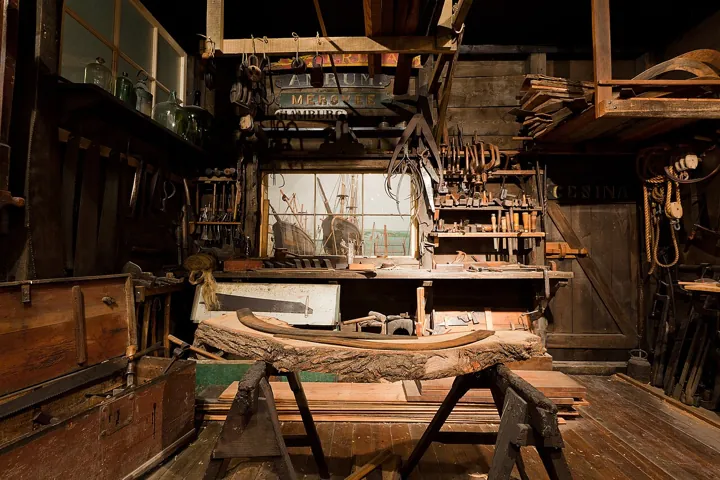
- A ship carpenter’s workshop
- Source
- Christoph Braun · original page
- Licence
- CC0 Public domain
 Design and engineering
Designing, documenting, reusing: the biases of the craftsman and the architect.
Designing, documenting, choosing a component: the craftsman and the architect have their own blind spots. We overvalue what we built ourselves, reject what comes from elsewhere, prefer the sophisticated to the simple, and explain badly what we know too well.
This family helps you re-read an architecture, a code review or documentation with fresh eyes. A good starting point: the curse of knowledge.
Over-engineeringWe prefer the sophisticated solution over the simple one because it seems more serious. Second-system effect, premature generalization: where it hits, how to spot it, and how to defend against it.The Curse of KnowledgeOnce we know something, we can no longer put ourselves in the shoes of someone who doesn't. Where it strikes (documentation, onboarding, specifications, training), how to spot it and work around it.The “Not Invented Here” syndromeWe reject a solution because it comes from outside. Where it strikes (component choices, reuse, open source, another team's tools), how to spot it and temper it without falling into the opposite excess.The IKEA effectWe overvalue what we built ourselves. Where it strikes (code review, redesigns, attachment to existing systems, in-house solutions), how to spot it, and how to keep enough distance to judge your own work.Pro-innovation biasNewness is judged as better by default, and anything old seems due for replacement. Where it hits (technology choices, monitoring, architecture, transformation), how to spot it, and how to compare an innovation to the current state based on facts.Functional fixednessWe only consider a tool, a piece of data or a practice in the use for which we know it. Where it strikes (problem solving, design, repurposing tools), how to spot it and how to loosen it.Self-serving biasWe credit ourselves for our successes and blame circumstances or other people for our failures. Where it strikes (post-mortems, incidents, project reviews, performance appraisals), how to spot it and how to defend against it.
