

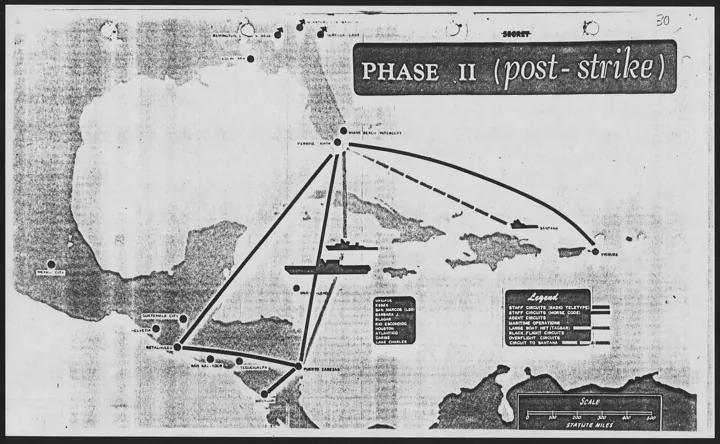
- Description
- The Bay of Pigs strike plan, 1961
- Source
- author not stated · original page
- Licence
- PD Public domain
 Groupthink
The more cohesive and self-assured a group is, the less you hear the voice that challenges.
In brief
- What: a cohesive group prefers consensus over serious review of options; doubts are no longer voiced.
- Why: cohesion, isolation, a leader steering the decision, time pressure; everyone self-censors and assumes others are convinced.
- Detect: quick unanimity, no alternatives examined, skeptics stay silent or are pushed aside (“he's not a team player”).
- Avoid: a designated critical evaluator, written opinions before discussion, a leader who speaks last, a second “last-chance” meeting.
Definition#
 Fictitious illustration
Groupthink is a mode of thinking in which members of a highly cohesive group place more importance on the search for unanimity than on a realistic evaluation of possible solutions. The term was popularized by American psychologist Irving Janis: in Victims of Groupthink (1972), he revisits several U.S. foreign policy decisions through the lens of social psychology, including the Bay of Pigs.
Janis describes eight symptoms: the illusion of invulnerability, collective rationalization of warnings, belief in the group's morality, stereotyped views of opponents, direct pressure on dissenters, self-censorship, the illusion of unanimity (silence means consent), and mindguards who filter disturbing information before it reaches the leader.
The mechanism#
For Janis, three families of conditions encourage the phenomenon: a highly cohesive group, structural faults (isolation, directive leader, no decision procedure, member homogeneity), and a stressful context (urgency, high stakes, recent failure). These produce symptoms, which in turn produce flawed decisions: few alternatives, poorly examined goals, ignored risks of the preferred solution, no backup plan.
The central effect is self-censorship: everyone keeps doubts to themselves, interprets others' silence as endorsement, and feels even more isolated in their skepticism. The group persuades itself, without anyone lying.
Where it appears#
In project management#
- Design review: the senior architect presents a solution, the team that designed it reviews it; no one objects because “we already decided” and “we don't have time to redo everything.”
- Steering committee: same participants, same sponsor, green indicators; bad news is softened upstream by those preparing the slide deck.
- Go / no-go: on the eve of production release, the person who sees a risk stays quiet so they won't be “the one blocking delivery.”
- Team bonded by past success: “we already pulled off three migrations, this one won't be a problem” (illusion of invulnerability).
In management#
- Leadership team: strategy is validated among peers who have known each other for a long time and share the same references; customers and front-line teams are not consulted.
- Leader states a preference upfront: the group aligns, then serves to legitimize the decision rather than discuss it.
- Dissenter marginalized: the person who raises the uncomfortable question is labeled “not committed enough,” which discourages the next ones.
Famous cases#
The Bay of Pigs April 1961#
Biases at play: groupthink (and authority, illusion of invulnerability).
What happened. Shortly after taking office, President John F. Kennedy authorized a plan prepared under the previous administration by the CIA: land, in the Bay of Pigs on Cuba's southern coast, a brigade of Cuban exiles trained by the United States in order to trigger Fidel Castro's downfall. The landing began on April 17, 1961; it was crushed in three days. More than 1,100 men were captured. Kennedy reportedly said to close aides, about this episode, something like: “How could we have been so stupid?”
Janis relies in part on testimony from historian Arthur Schlesinger, an adviser to the president, who recounts in A Thousand Days (1965) that he had doubts, voiced them only very timidly in meetings, and regretted it. The plan relied on assumptions barely examined in meetings, for example the idea that an uprising of the Cuban population would follow the landing. Senator J. William Fulbright, invited in early April, opposed it; coming from outside, his voice did not overturn the decision circle's consensus. Eighteen months later, during the Cuban Missile Crisis (October 1962), Kennedy organized deliberation differently: subgroups working separately, the president present or absent depending on the session so as not to steer discussion, input requested from outsiders, and a challenger role assigned to his brother Robert. Janis sees this as an illustration of the remedies.
What this illustrates
The error did not come from a lack of intelligence (the group included brilliant people) but from the way decisions were made: a leader already leaning one way, doubts that did not surface, no formal confrontation with a counterargument. The second crisis shows that you can fix the process without changing the people. Still, be careful not to treat it as proof: this is Janis's after-the-fact reading of two very different episodes.
Challenger: a frequently cited case, a debated cause January 27-28, 1986#
Biases at play: groupthink (debated thesis), normalization of deviance.
What happened. On January 28, 1986, the space shuttle Challenger disintegrated seventy-three seconds after liftoff. The presidential commission (Rogers Commission) established that the technical cause was failure of an O-ring in a solid rocket booster, made less flexible by the cold. The day before, during a teleconference, engineers from manufacturer Thiokol had recommended not launching in such cold weather; after a break in which Thiokol management consulted among themselves, the recommendation was reversed and the launch was confirmed. Some researchers (for example Esser and Lindoerfer, 1989) looked for groupthink symptoms in this sequence.
What this illustrates
Nuance is essential. Sociologist Diane Vaughan (The Challenger Launch Decision, 1996) argues, based on archives, that the main cause was less group dynamics than normalization of deviance: O-ring anomalies observed flight after flight without catastrophe had eventually been accepted as normal risk. There were also open disagreements, which fits poorly with a unanimous group. What can be retained without overreach: the decision was made under pressure, by managers who reversed the burden of proof (“prove it's dangerous” instead of “prove it's safe”). Do not label a failure “groupthink” by reflex; first look at what the investigation says.
The contaminated blood scandal: a system without contradiction (France) 1985-1992#
Biases at play: groupthink (interpretation), along with authority bias.
What happened. The contaminated blood scandal, recounted in the Authority bias page, unfolded in 1985 in a transfusion system where CNTS, transfusion centers, and the supervising administration passed decisions back and forth. On May 29, 1985, an internal CNTS meeting maintained distribution of non-heated products; systematic donor screening did not come into effect until August 1, 1985. The Senate, which issued its report on June 11, 1992, described a “fragmented” decision-making process and an institution “left to itself.”
Where the bias appears. The inquiry commission describes “progressive intellectual isolation”: the transfusion system was challenged neither from outside nor from within, and “doubt scarcely had a right to exist there.” This echoes Janis's groupthink (insularity, absence of dissenting voices, confidence in the group's correctness). But the commission demonstrates neither self-censorship nor pressure toward unanimity in a specific decision, and its findings are just as consistent with a simple lack of external oversight, industrial and financial stakes, and diluted responsibility across institutions. Groupthink is therefore a plausible reading, not a documented mechanism. Level of evidence: accepted, not proven. The Senate describes unchallenged insularity, not the group dynamic itself.
What this illustrates
In any institution that is never contradicted, organize contradiction: external oversight, a devil's advocate, and independent review of sensitive decisions.
Detection signals#
- The decision is made very quickly and without disagreement on a topic that should normally provoke some.
- Only one option is truly examined; the others are mentioned “for appearances”.
- Warnings are explained away (“he's not in the context,” “he's exaggerating”) instead of being examined.
- After the meeting, doubts are voiced over coffee or in private messages: the real disagreement exists, but outside the room.
- “We're in the best position to know”: outside opinions are not sought.
- The leader gave their opinion at the start of the meeting.
Avoidance reflexes#
- Appoint a critical evaluator. Someone whose explicit role is to look for flaws, on a rotating basis so it's not always the same person or a personal stance.
- Collect opinions in writing before discussing. Individual notes submitted before the meeting, or anonymous simultaneous voting: herd effects and self-censorship are short-circuited.
- The leader speaks last, and does not reveal their preference until the group has explored the options.
- Require multiple options. No decision goes to committee without at least two seriously compared alternatives, including “do nothing.”
- Run a pre-mortem. “It's a year from now, the project failed: why?” This exercise, popularized by Gary Klein, gives people permission to say what they think.
- Consult externally. A peer from another team, an independent expert, a real user, with explicit instructions to challenge.
- Plan a second meeting. After the decision, revisit it once “with a cool head,” so everyone can express remaining doubts (Janis's “last chance meeting”).
- Reward bad news. Publicly thanking the person who raises a risk is the only way to make disagreement safe.
With AI: detect, fix, mitigate#
AI has no reputation to defend or career to protect: it can play the devil's advocate at no social cost. But an assistant also tends to go along with its interlocutor: phrase the request so it contradicts (“find the flaws”), and don't first give it the group's conclusion.
Detect#
- Identify, in an anonymized report, decisions made without alternatives mentioned and without objections.
- Spot closing language (“everyone agrees,” “we've already decided”).
- Compare written opinions before the meeting with the final decision.
Fix#
- Play the challenger: list the strongest objections to a proposal.
- Produce a pre-mortem based on the decision file.
- Suggest alternative options and their comparison criteria.
Mitigate#
- Collect individual views in an anonymous form and produce a synthesis faithful to disagreements.
- Prepare in advance the questions to ask each committee member.
- Draft a report that preserves the reservations expressed, not just the decision.
Prompts to integrate into your practices#
1. Devil's advocate. To run before the decision meeting, without telling it what the group thinks.
Here is a proposal submitted to a decision committee: [description, context, constraints].
You are not here to approve it. Give the seven strongest objections, ranked from most serious to least serious.
For each one: the assumption the proposal relies on, what would happen if it were false, and one data point or simple test that could verify it.
Do not invent any statistics: if you don't have a source, say so.
2. Pre-mortem. To give people permission to voice doubts before it's too late.
We are twelve months in the future. The project described below has failed and everyone kind of expected it.
Project: [description].
Using realistic mechanisms, write ten distinct reasons for this failure: technical, organizational, human, contractual.
For each reason, indicate one early signal observable in the next three months and one preventive measure.
3. Review of a decision report. On an anonymized text.
Here is the report (without names) of a decision meeting: [text].
Tell me: how many options were actually discussed; which risks were raised then dismissed without justification; whether objections were raised and then dropped; which questions were not asked.
Conclude with three questions to ask the group before confirming the decision. Do not judge people.
How to integrate them#
- Before the committee: the critical evaluator runs prompt 1 and extracts three questions from it.
- At project kickoff: the pre-mortem (prompt 2) is read aloud, then completed by the team.
- After the decision: prompt 3 is used to prepare the “last chance meeting.”
Precautions#
- AI produces plausible objections, not necessarily relevant to your context: sort them, do not apply them wholesale.
- Do not present its objections as expert advice: they are meant to start the discussion.
- Do not turn it into an alibi (“AI didn't find anything”): the absence of objections from it validates nothing.
- Do not paste confidential or personal data into an unauthorized tool.
Limits#
- Janis's model is more convincing as an interpretive framework than as a proven theory. Research reviews (Park, 1990; Aldag and Fuller, 1993) conclude that its components are unevenly supported: cohesion alone is not enough to predict bad decisions, and Janis's case studies were selected because the decision had failed.
- A cohesive group is not a bad thing: cohesion, combined with good procedures and a leader who gives others the floor, improves decision quality.
- Labeling a bad decision as “groupthink” is a potential hindsight bias: a decision can fail even if the process was not flawed.
- Do not confuse it with herd behavior (following the crowd) or Asch conformity (contradicting your own eyes): the driver of groupthink is cohesion and the desire to preserve harmony.
Sources and verification#
- Janis (1972), Victims of Groupthink: A Psychological Study of Foreign-Policy Decisions and Fiascoes, Houghton Mifflin; expanded second edition: Groupthink (1982).
- Schlesinger (1965), A Thousand Days: John F. Kennedy in the White House, Houghton Mifflin.
- John F. Kennedy Presidential Library, “The Bay of Pigs” — dates, timeline, outcome.
- Report of the Presidential Commission on the Space Shuttle Challenger accident (1986) — technical cause, temperature, eve-of-launch teleconference.
- Vaughan (1996), The Challenger Launch Decision: Risky Technology, Culture, and Deviance at NASA, University of Chicago Press.
- Esser & Lindoerfer (1989), “Groupthink and the space shuttle Challenger accident: Toward a quantitative case analysis,” Journal of Behavioral Decision Making, 2(3).
- Park (1990), “A review of research on groupthink,” Journal of Behavioral Decision Making, 3(4), 229-245.
- Aldag & Fuller (1993), “Beyond fiasco: A reappraisal of the groupthink phenomenon and a new model of group decision processes,” Psychological Bulletin
- Klein (2007), “Performing a Project Premortem,” Harvard Business Review, September.
- Senate (1992), Report no. 406 of the commission of inquiry into the French blood transfusion system, June 11, 1992 — “progressive intellectual isolation” of the transfusion system and a “fragmented” decision process; does not use Janis's model.
See also#
Related biases#
Variants or cousins: not to be confused.
Counterweights and related reflexes#
What neutralises it.
- The devil's advocate
- The pre-mortem
- Le vote anonyme et simultané (concept or method, no page)
