

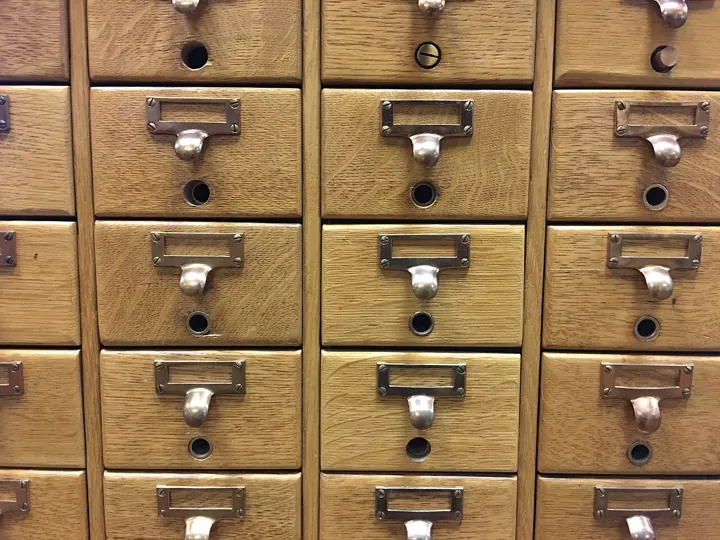
- Description
- A library card catalog cabinet
- Source
- MarkBuckawicki · original page
- Licence
- CC0 Public domain
 Reasoning and information
How we weigh information, figures and arguments.
Reasoning always starts from information: a figure, an anecdote, an example. This family gathers the biases that alter the way we weigh information: the first number that anchors, what we remember because it is easy to retrieve, what confirms what we think, presentation as gain or loss, the silent failures we do not see.
It also contains wishful thinking, with the sniffer-planes case.
AnchoringThe first number heard becomes the reference point, even if it's arbitrary. Where it hits (estimation, budget, negotiation, evaluation), how to spot it and defend against it.Confirmation biasWe seek out, interpret, and retain what supports the idea we already have. Where it strikes (bug diagnosis, technical choices, reviews, data analysis, evaluating a person), how to spot it and contain it.Availability heuristicWe judge the probability of an event by how easily we remember it. Where it strikes (risk management, post-mortems, prioritization), how to spot it and how to defend against it.The representativeness heuristicWe judge the probability of something by its resemblance to a typical image, forgetting the actual proportions. Where it strikes (analogy-based estimating, recruitment, diagnosis), how to spot it and how to defend against it.The framing effectThe same information, presented as a gain or as a loss, leads to different decisions. Where it strikes (committees, progress reports, negotiation, feedback), how to spot it and how to defend against it.Survivorship biasWe draw lessons from those who succeeded or survived, forgetting those who disappeared from the data. Where it strikes (benchmarks, feedback, practices “that work”), how to spot it and defend against it.Hindsight biasOnce the outcome is known, it seems like it was predictable, and we remember having predicted it. Where it strikes (retrospectives, incidents, decision evaluation), how to spot it and defend against it.Wishful thinkingWe believe what we'd like to be true, and we accept overly favorable evidence without examining it. Where it hits (investment, solution acceptance testing, vendor selection, demonstrations), with the textbook case of the “sniffer planes.”
