

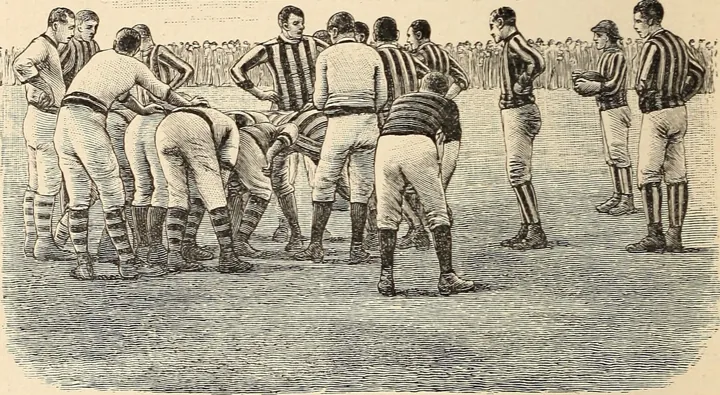
- Description
- Gravure ancienne d'une mêlée de rugby en train de se former
- Source
- auteur non indiqué · original page
- Licence
- PD Public domain
 Scrum, the Framework (Scrum Guide 2020)
You will be able to describe Scrum as defined by the Scrum Guide 2020: empirical theory, values, team, roles, five events, three artifacts and their commitments.
In brief
- You will be able to describe Scrum as defined by the Scrum Guide 2020: empirical theory, values, team, roles, five events, three artifacts and their commitments.
- You will distinguish what the Guide prescribes (the framework, intentionally minimal) from what practice adds (user stories, points, velocity: none of that is in the Guide).
- You will be able to read an expert's subtleties: why Sprint Review is not a validation demo, why the retrospective is the engine of the framework, what “usable increment” means.
- You will be able to identify what Scrum is not (a complete project management method, a control tool, a schedule).
- Implementations and pitfalls are in Scrum in Practice; BI application is in Scrum and data.
Source and status. Reference text: The Scrum Guide (Ken Schwaber and Jeff Sutherland, November 2020, scrumguides.org, translated into French). Verification (status 2026-10): the 2020 version remains the current published version; no more recent revision had been confirmed at the time of writing. The wording below is the author's paraphrase, not quotations; only the official text is authoritative.
On this page
- 🟢 Beginner — Scrum in one page
- 🟢 Beginner — Empirical theory: three pillars
- 🟢 Beginner — The five values
- 🟢 Novice — The Scrum Team
- 🟢 Novice — The three accountabilities
- 🟡 Practical — The five events
- 🟡 Practice — The Sprint
- 🟡 Practice — Sprint Planning
- 🟡 Practice — Daily Scrum
- 🟡 Practice — Sprint Review
- 🟡 Practice — Sprint Retrospective
- 🟡 Practice — The Three Artifacts and Their Commitments
- 🟡 Practice — Product Goal
- 🟡 Practice — Sprint Goal
- 🟡 Practice — Definition of Done
- 🔴 Expert — Expert Readings of the Guide
- 1. Scrum is an empirical process control framework, not a plan
- 2. The asymmetry “firm goal, flexible scope”
- 3. “Does everything visible have the same status?”
- 4. Increment and deployment: two distinct concepts
- 5. Self-management does not mean no constraints
- 6. The underestimated role of the Scrum Master: organizational change agent
- 7. The apparent contradiction: “one Sprint, one team, one Product Goal”
- 8. Predictability: through duration, not through control
- 🔴 Expert — What the Guide Does Not Say
- 🔴 Expert — What Scrum Is Not
- 🔴 Expert — Guide Evolution: 2010 → 2017 → 2020
- Metrics: Scrum by Selected Criteria
- AI Contribution
- See also
Level: 🟢→🔴
🟢 Beginner — Scrum in one page#
Scrum is a lightweight framework (framework) that helps people, teams, and organizations create value by delivering adaptive solutions to complex problems. Scrum is a framework, not a complete method: other processes and techniques are used within it. The Guide says it is intentionally incomplete: it defines only the parts required to implement Scrum theory.
The principle: a single cross-functional team delivers a usable Increment at short, regular intervals (the Sprints, one month or less). At the end of each Sprint, the team inspects what was produced and how it worked, then adapts.
The elements at a glance#
| Category | Elements |
|---|---|
| Empirical pillars | Transparency, Inspection, Adaptation |
| Values | Commitment, Focus, Openness, Respect, Courage |
| Team (Scrum Team) | 1 Product Owner, 1 Scrum Master, Developers (generally 10 people or fewer in total) |
| Events | Sprint (container), Sprint Planning, Daily Scrum, Sprint Review, Sprint Retrospective |
| Artifacts → commitment | Product Backlog → Product Goal ; Sprint Backlog → Sprint Goal ; Increment → Definition of Done |
Remember the symmetry of artifacts: each has a commitment that gives it a measurable direction. The Product Goal guides the Product Backlog, the Sprint Goal guides the Sprint Backlog, and the Definition of Done gives quality to the Increment. A team without these three commitments is “doing Scrum” without Scrum's meaning.
🟢 Beginner — Empirical theory: three pillars#
Scrum is based on empiricism (knowledge comes from experience; decisions are made from what we observe) and Lean thinking (reduce waste, focus on what matters). It opposes the idea that everything can be predicted in a complex problem (see the Cynefin framework in Project Management Fundamentals). Its approach is iterative and incremental to optimize predictability and control risk.
Three pillars support any empirical process control implementation:
| Pillar | Meaning | Without it… | BI illustration |
|---|---|---|---|
| Transparency | The process and the work are visible to those doing it and those receiving it; key terms (“done”) are defined in a shared way | You inspect a fiction; decisions are made on false assumptions | The Product Backlog, acceptance testing status, and figure discrepancies are accessible to everyone |
| Inspection | Artifacts and progress toward goals are examined frequently and diligently to detect undesirable deviations | Problems accumulate unseen | Sprint review with real numbers, not mockups |
| Adaptation | When a process deviates outside acceptable limits or the product is unacceptable, adjustments are made as early as possible | Inspection becomes useless reporting | Reordering the backlog after seeing the source is less reliable than expected |
These three pillars are interdependent: transparency makes inspection possible, inspection makes adaptation relevant; without adaptation, inspection is only an observation. Scrum's five events are designed as opportunities for inspection and adaptation.
Incomplete transparency. Symptom: “everything is green” in review, then surprise during acceptance testing. Cause: the Definition of Done does not include number reconciliation or performance; what is “done” for the team is not done for the business. Remedy: make the DoD honest (see Definition of Done) and show real numbers at every review.
The Guide also indicates that if you change Scrum's rules, the framework can lose coherence: “Scrum is only Scrum” in its entirety, which allows isolated elements to be adopted, but the Guide says full benefit comes from the whole. See ScrumBut for common drifts.
🟢 Beginner — The five values#
The values are not decorative: they describe the behavior without which the pillars collapse. The Guide states that team members learn and explore these values by working with the events and artifacts, and that decisions, actions, and the way Scrum is used must reinforce these values, not weaken them.
| Value | Meaning | What it looks like in practice | Its absence is visible when… |
|---|---|---|---|
| Commitment (Commitment) | Commit to achieving team goals and supporting one another | You commit to a goal, not a list of tasks | Everyone defends “their” ticket |
| Focus | Concentrate on Sprint work and goals | One Product Goal; little work in progress | Ten open topics, none completed |
| Openness (Openness) | Be open about work and challenges | Delays are raised as soon as they are seen | Bad news surfaces at review |
| Respect | Respect each other as capable, independent people, and be respected as such | No micromanagement; Developers' input matters | The PO dictates the technical solution |
| Courage | Have the courage to do the right thing and tackle hard problems | Saying “no,” rejecting an unready item, stopping a dead-end effort | Unrealistic deadlines are accepted “to avoid upsetting people” |
A Developer notices that a data source provides duplicate keys. Openness: they bring it up in the Daily. Courage: the team proposes removing the item from the Sprint rather than delivering a wrong number. Respect: the PO listens to the argument instead of demanding. Focus: the team redirects the Sprint Goal. Commitment: the sprint objective is preserved, even if the content changes.
🟢 Novice — The Scrum Team#
One team, not sub-teams#
The fundamental unit of Scrum is a small team: one Scrum Master, one Product Owner, and Developers. There are no sub-teams or hierarchies within the Scrum Team: it is a single unit devoted to the same objective, the Product Goal.
Characteristics described by the Guide:
- Cross-functional: together, members have all the skills needed to create value every Sprint.
- Self-managing (self-managing): they decide internally who does what, when, and how. The 2020 Guide replaced “self-organizing” with “self-managing” to emphasize this point: the team does not just organize itself, it decides.
- Size: generally 10 people or fewer. The larger the team gets, the more complex communication becomes; beyond that, it is better to have multiple teams around the same product (same Product Goal, same Product Backlog, same PO).
- Responsible for all product-related activities: stakeholder collaboration, verification, maintenance, operations, experimentation, research and development, and everything else required.
The BI “cross-functionality” test: can the team, without stepping outside itself, go from source to report screen (extraction, modeling, queries, DAX measures, layout, number testing, deployment)? If one step depends on an external team for every item, that external bottleneck sets the pace. This is covered in Scrum and data.
The term “Developers”#
In the 2020 Guide, Developers refers to the people who commit to creating any aspect of a usable Increment each Sprint: software developers, but also analysts, testers, data specialists, BI specialists, UX specialists, etc. The term is therefore not limited to programmers. The exact skills vary by domain. The 2020 Guide dropped the phrase “Development Team” to remove the idea that a separate sub-team exists.
🟢 Novice — The three accountabilities#
The Guide talks about accountabilities rather than roles: what each person must answer for. One point to watch: accountability = answerability (duty to report), stronger than responsibility.
Product Owner#
Accountable for maximizing the value of the product resulting from the Scrum Team’s work. How to achieve this varies greatly across organizations. The PO is accountable (and may delegate work, but remains solely accountable) for the effective management of the Product Backlog:
- developing and explicitly communicating the Product Goal;
- creating and clearly communicating Product Backlog items;
- ordering Product Backlog items;
- ensuring the Product Backlog is transparent, visible, and understood.
The PO is one person, not a committee. For their authority to be real, the entire organization must respect their decisions, visible in the Product Backlog’s content and ordering and in the Increment inspected at Sprint Review. Stakeholders can request changes by convincing the PO, not by bypassing them.
The ghost PO or committee PO. Symptom: the backlog is a pile of requests; no one decides; the PO “passes things along” to Developers. Cause: the PO has neither authority nor availability. Remedy: appoint one person with an explicit mandate, and reserve time (the PO is not “10% of someone” on an active product).
Scrum Master#
Accountable for establishing Scrum as defined in the Guide, by helping everyone understand Scrum theory and practice, both within the team and across the organization. Accountable for the Scrum Team’s effectiveness, by helping it improve its practices within Scrum. This is a true leader who serves (true leader who serves) the team and the organization.
They serve:
| With… | Examples (from the Guide) |
|---|---|
| The Scrum Team | Coaching self-management and cross-functionality; helping focus on high-value Increments that meet the DoD; causing the removal of impediments to progress; ensuring all events take place, are positive, productive, and kept within their timebox |
| The Product Owner | Helping find techniques to define the Product Goal and manage the Product Backlog; helping the team understand the need for clear, concise backlog items; helping establish empirical product planning; facilitating stakeholder collaboration |
| The organization | Leading, training, and coaching the organization in its Scrum adoption; planning and advising implementations; helping employees and stakeholders understand the empirical approach; removing barriers between stakeholders and teams |
The Scrum Master is neither a project manager, nor a meeting secretary, nor a process controller: they do not assign work, do not manage scheduling, and do not do individual progress reporting.
Developers#
Accountable for:
- creating a plan for the Sprint: the Sprint Backlog;
- instilling quality by adhering to a Definition of Done;
- adapting their plan every day toward the Sprint Goal;
- holding each other accountable as professionals.
They are the ones who estimate (the Guide specifies that Developers size the work) and decide the amount of work they can commit to delivering: neither the PO nor the SM imposes the volume.
Summary table of accountabilities#
| Topic | PO | SM | Developers |
|---|---|---|---|
| Product Goal | Defines and communicates | Helps with techniques | Contribute |
| Product Backlog order | Decides | Facilitates | Consulted |
| Sprint Goal | Proposes direction, negotiates | Facilitates | Commit to the goal with the PO (created collectively) |
| Sprint Backlog | Participates | Facilitates | Own |
| Amount of Sprint work | Influences through ordering | Does not impose | Decide |
| Definition of Done | Contributes (if org standard, follows it) | Ensures it exists and is used | Follow / define if non-standard |
| Process effectiveness | Participates | Accountable | Participate |
| Technical quality | Value expectations | — | Accountable |
Scrum roles are accountabilities, not HR job functions. The same person can be both SM and Developer (common in small teams), but combining PO and SM is generally discouraged: tensions (value/timeline vs quality/process) are structural. Combining PO and Developer is possible but demanding. See Setting up a team.
🟡 Practical — The five events#
Scrum events create regularity and minimize the need for unplanned meetings. Each is a formal opportunity to inspect and adapt an artifact. They are held within their timebox (maximum duration) and, ideally, at the same time and place to reduce complexity. The Sprint is the container for the others.
| Event | Purpose | Max timebox (1-month Sprint) | Inspects | Adapts |
|---|---|---|---|---|
| Sprint | Container; idea → value | 1 month or less | Progress toward the Sprint Goal | Sprint Backlog |
| Sprint Planning | Define the work to be done | 8 h (shorter for shorter Sprints) | Product Backlog, capacity, Definition of Done | Sprint Backlog, Sprint Goal |
| Daily Scrum | Inspect progress toward the Sprint Goal; adapt the plan | 15 min | Progress toward the Sprint Goal, trend | Sprint Backlog |
| Sprint Review | Inspect the Sprint outcome; determine adaptations | 4 h | The Increment, the environment, needs | Product Backlog |
| Sprint Retrospective | Plan ways to increase quality and effectiveness | 3 h | The way of working: people, interactions, processes, tools, DoD | Way of working, DoD, improvement plan |
For a shorter Sprint, events are generally shorter too (proportionally). The durations above are maximums, not targets.
🟡 Practice — The Sprint#
The heart of Scrum, the Sprint is an event of one month or less, with a consistent duration, during which ideas are turned into value. A new Sprint starts immediately after the previous one ends. All work needed to achieve the Product Goal (planning, daily development, review, retrospective) happens within Sprints.
During the Sprint:
- no changes are made that would put the Sprint Goal at risk;
- quality does not decrease;
- the Product Backlog is refined as needed;
- the scope may be clarified and renegotiated with the PO as more is learned.
Why a fixed duration#
A Sprint with a consistent duration creates a rhythm: the team learns its capacity, stakeholders know when they will get information, and predictability emerges. Short Sprints: more learning cycles, with risk limited to less than one month of cost. The Guide allows “one month or less”; most teams choose one to two weeks (an order of magnitude from practice, not a Guide rule).
| Duration | Benefits | Limits | Best suited for |
|---|---|---|---|
| 1 week | Very fast feedback; low risk | Heavy ceremony relative to actual work; little room for an ambitious increment | Very mature teams; simple products; discovery phase |
| 2 weeks | Common compromise | Fewer cycles | General case |
| 3–4 weeks | Time for a substantial increment | Late feedback; possible drift; accumulation risk | Contexts with high inertia (long integration, large-volume data) |
Making the Sprint longer “because tasks are big.” Symptom: moving to 4 weeks to fit in one item. Cause: the item is not split enough. Remedy: split it (see vertical slicing) rather than extending the cycle. Except in data cases where the processing cycle itself is long: see Scrum and Data.
Canceling a Sprint#
A Sprint can be canceled before the end of its timebox, only by the Product Owner, typically when the Sprint Goal has become obsolete (organizational direction change, market or technology shift). This is rare, costly (all planning work is lost), and disruptive; items already completed and compliant with the DoD are reviewed, and the rest is put back into the Product Backlog. Short Sprints are better than cancellation.
🟡 Practice — Sprint Planning#
Sprint Planning initiates the Sprint by defining the work to be done. This plan is the result of the collaborative work of the entire Scrum Team. The PO ensures participants are ready to discuss the most important Product Backlog items and how they relate to the Product Goal. The Scrum Team may invite others for advice.
The Guide structures Planning around three topics:
| Topic | Question | Content |
|---|---|---|
| 1. Why is this Sprint valuable? | Value | The PO proposes how the product could increase its value and usefulness; the entire Scrum Team defines a Sprint Goal that communicates why the Sprint is valuable to stakeholders. The Sprint Goal must be set before the end of Planning |
| 2. What can be completed in this Sprint? | What | With the PO, the Developers select Product Backlog items. The Scrum Team may refine items during this process. Choosing what can be achieved can be difficult: the more Developers know their past performance, capacity, and DoD, the more confident they are in their forecast |
| 3. How will the selected work get done? | How | For each selected item, the Developers plan the work needed to create a DoD-compliant Increment, often by breaking it down into work items of one day or less. How to do this is solely up to the Developers |
The Sprint Goal, the selected items, and the plan to deliver them together form the Sprint Backlog.
Start Planning with the Sprint Goal (the “why”) before selecting items. Planning that starts from a task list produces a catch-all Sprint with no coherence.
Data Sprint Goal: “Regional managers can view revenue by customer and by month, reconciled with the source to within less than 0.1% (accepted variance, to be defined with the business), for the pilot region.” Selected items: fact table loaded for the pilot region, customer dimension, revenue measure, one report page, reconciliation test. The goal aligns the team; the task list follows from it.
Capacity and forecasting#
The Guide prescribes neither velocity nor story points. Developers use what they know about their capacity (availability, vacations, dependencies) and their history to forecast. Detailed estimation techniques are covered in Scrum in Practice.
🟡 Practice — Daily Scrum#
Purpose: inspect progress toward the Sprint Goal and adapt the Sprint Backlog as needed by adjusting upcoming planned work.
- 15 minutes, every working day of the Sprint, at the same time and place to reduce complexity.
- Participants: Developers. If the PO or SM are actively working on Sprint Backlog items, they participate as Developers.
- The structure is flexible: Developers choose the format (the 2020 Guide removed the three ritual questions “what did I do yesterday? what will I do today? what impediments do I have?” — often kept out of habit, but not prescribed), as long as it focuses on progress toward the Sprint Goal and produces an action plan for the next day.
- It improves communication, identifies obstacles, promotes rapid decision-making, and thus removes the need for other meetings.
- It is not the only time to adjust the plan: Developers often meet right after for detailed discussions.
| Format | Principle | When |
|---|---|---|
| Three questions | Each person takes turns | Beginner team; risk of a “reporting roundtable” |
| By goal / “walk the board” | Walk the board right to left (items closest to “Done” first) | Mature teams, strong flow orientation |
| By risk to the Sprint Goal | “What threatens our goal?” | Sprints with dependencies |
The Daily as a status meeting for the boss. Symptom: everyone speaks to the Scrum Master or the manager present. Cause: the ritual is seen as control. Remedy: Developers speak to each other; the manager observes silently or does not attend; discuss the goal, not tasks.
🟡 Practice — Sprint Review#
Purpose: inspect the Sprint outcome and determine future adaptations. The Scrum Team presents the results of its work to key stakeholders, and progress toward the Product Goal is discussed.
Flow described by the Guide: the Scrum Team and stakeholders review what was accomplished in the Sprint and what changed in their environment; on that basis, participants collaborate to determine what to do next. The Product Backlog may be adjusted to capture new opportunities. This is a working session, not a presentation: the Guide specifies it must not be limited to a demo. It includes a review of trends (timeline, budget, what is likely to be delivered) and the timeline.
| Myth | Reality |
|---|---|
| “The Review is a validation demo” | It is a collaborative inspection; quality validation happens continuously through the DoD |
| “It is used to accept items” | An item is “Done” or it is not; the Review gathers feedback and reorients |
| “Only the PO attends” | Key stakeholders (users, sponsor, ops) are invited |
| “We show mockups” | We show the real Increment, real numbers |
In BI, show real reconciled numbers: open the report on a known business sample (one customer, one month) and ask “is this the number you expect?”. This is the richest form of inspection. For the concept of acceptance testing, see Scrum and Data.
🟡 Practice — Sprint Retrospective#
Purpose: plan ways to increase quality and effectiveness. The Scrum Team inspects how the Sprint went regarding people, interactions, processes, tools, and the Definition of Done. It identifies what worked well, problems encountered, how they were (or were not) resolved, and selects the most useful changes. The most impactful improvements are adopted as quickly as possible; they may even be added to the next Sprint's Sprint Backlog.
It concludes the Sprint; 3 hours max for a one-month Sprint; it takes place after the Review and before the next Sprint.
The retrospective is Scrum's improvement engine: without it, the framework is reduced to a meeting calendar. Three tests of a healthy retro: (1) it produces one to three concrete actions, scheduled, with an owner; (2) actions from the previous Sprint are reviewed; (3) difficult topics (conflicts, debt, dependencies on a third party) are addressed. Formats and anti-patterns are described in Scrum in Practice.
🟡 Practice — The Three Artifacts and Their Commitments#
Scrum artifacts represent work or value. They are designed to maximize transparency of key information. Each contains a commitment that improves transparency and focus:
| Artifact | Commitment | Role of the commitment |
|---|---|---|
| Product Backlog | Product Goal | Describes a future state of the product; a planning target for the team |
| Sprint Backlog | Sprint Goal | Single Sprint objective; flexibility in the work to achieve it |
| Increment | Definition of Done | Quality state that makes the increment usable |
Product Backlog#
An emergent, ordered list of what is needed to improve the product. The single source of work undertaken by the Scrum Team. Items small enough to be completed within a Sprint are considered ready to be selected in Planning, generally after refinement activities.
Refinement is the activity of further breaking down and defining Product Backlog items into smaller, more precise items. It is a continuous activity: details, descriptions, order, and size are added. Attributes vary by domain. The Developers are responsible for sizing; the PO can help by clarifying and arbitrating. The 2017 Guide stated that refinement should not exceed about 10% of Developers' capacity; the 2020 Guide no longer mentions this (this range remains a common practical benchmark).
The 2020 Guide adds: “Product Goal,” “the Product Backlog evolves as the product and environment evolve; it is alive.” A Product Backlog is never complete.
Sprint Backlog#
Composed of the Sprint Goal (why), the set of Product Backlog items selected for the Sprint (what), and an actionable plan for delivering the Increment (how). It is a plan by and for the Developers, a highly visible, real-time picture of planned work, updated throughout the Sprint as learning occurs. It must contain enough detail for progress to be inspectable during the Daily Scrum.
Increment#
An Increment is a concrete step toward the Product Goal. Each Increment is additive to all previous Increments and thoroughly verified, to ensure that all Increments work together. To provide value, the Increment must be usable. Multiple Increments can be created in the same Sprint, and their sum is presented at the Sprint Review. Work can only be considered part of an Increment if it meets the Definition of Done. An item that does not meet it cannot be released or presented in Review; it returns to the Product Backlog.
🟡 Practice — Product Goal#
The Product Goal describes a future state of the product that can serve as a planning target for the Scrum Team. It is in the Product Backlog: the rest of the backlog emerges to define what fulfills the Product Goal.
- Only one at a time: the Scrum Team must fulfill or abandon one objective before adopting another.
- It is the team's long-term commitment, and the team must be able to say whether it has achieved it.
- A product is a vehicle for delivering value: it has clear boundaries, identified stakeholders, and well-defined users or customers; it can be a service, a physical product, or a more abstract object.
Bad Product Goal: “Have an awesome datamart.” Good Product Goal: “By the end of Q2, the 40 area managers run their routes from a single dashboard, updated every morning, with figures reconciled with the SFA source.” It is verifiable, usage-oriented, and bounded.
🟡 Practice — Sprint Goal#
The Sprint Goal is the Sprint's single objective. Although it is a commitment by the Developers, it offers flexibility regarding the exact work needed to achieve it. It creates coherence and focus, encouraging the team to work together rather than on separate initiatives. It is created during Sprint Planning and added to the Sprint Backlog. If the work turns out to be different from what the Developers expected, they collaborate with the PO to negotiate the scope of the Sprint Backlog, without affecting the Sprint Goal.
Sprint Goal as an “item list.” “Complete tickets 12, 15, and 19” is not an objective. An objective answers why; the list is only the likely how. Without an objective, there is no scope flexibility, and therefore no possible negotiation when something unexpected happens.
🟡 Practice — Definition of Done#
The Definition of Done (DoD) is a formal description of the state of the Increment when it meets the quality measures required for the product. The moment a Product Backlog item meets the DoD, an Increment is born.
- It creates a shared understanding of what “done” means: transparency.
- If an Increment's DoD is part of the organization's standards, all Scrum Teams must follow it at minimum. Otherwise, the Scrum Team must create one suited to the product.
- The Developers must comply with it; if multiple Scrum Teams work together on one product, they must define and follow the same DoD.
- It evolves: at each retrospective, the team can tighten its DoD; it never relaxes it to hit a date (that would destroy transparency).
| DoD maturity level | Content example | Warning sign |
|---|---|---|
| Low | “Coded and tested by the developer” | “Done” means nothing to the business |
| Medium | Code review, passing automated tests, deployed in acceptance testing | No criterion on data or performance |
| Strong | Quality, security, performance, documentation, figure reconciliation, reproducible automated deployment | — |
A DoD suited to data is detailed in Scrum and Data; the distinction from Definition of Ready is in Scrum in Practice.
🔴 Expert — Expert Readings of the Guide#
1. Scrum is an empirical process control framework, not a plan#
A close reading of the Guide shows that almost everything in Scrum serves one single idea: shortening the feedback loop so that inspection leads to adaptation. Events are not meetings but learning synchronization points; the Sprint is a risk boundary (at worst, you lose one Sprint); the DoD is a quality boundary (nothing less than “usable”); the Sprint Goal is a degree of freedom (scope flexibility, firmness of intent).
2. The asymmetry “firm goal, flexible scope”#
One of Scrum’s deepest moves: you fix time and quality and negotiate scope. The Product Owner can change the Sprint Backlog content if the goal is threatened; Developers can reduce scope to preserve the DoD. This contradicts the predictive reflex (fixed scope, variable quality) and explains why Scrum is misunderstood in organizations that contract for scope.
3. “Does everything visible have the same status?”#
The Guide does not define a “nearly done” state. An item is Done or it is not: this prevents the “90% done” pattern, a classic illusion that hides remaining work. The operational consequence: slice work so each item fits within one Sprint and is completed rather than starting lots of things.
4. Increment and deployment: two distinct concepts#
The Increment must be usable; production release remains a PO decision (the Guide does not say “every Sprint”). Continuous deployment teams often publish several times a day (several Increments per Sprint), others deliver at Sprint end; others still accumulate several Sprints before a commercial release (the case of datamarts delivered in kits). In all cases, the Increment exists every Sprint, and it is potentially releasable: quality is the same as if it were going to production. The question of delivery frequency is addressed in CI/CD: Continuous Integration and Continuous Delivery and CI/CD for data: foundations, datamarts, pipelines, and reports.
5. Self-management does not mean no constraints#
Self-management operates within a framework: the Product Goal, the DoD, the organization’s standards. The team decides how, work allocation, and quantity; it does not decide value on its own (PO), nor does it bypass standards. It is also accountable: autonomy is inseparable from transparency and inspection.
6. The underestimated role of the Scrum Master: organizational change agent#
The 2020 Guide explicitly broadens the SM beyond the team: they help the organization adopt Scrum, remove barriers between stakeholders and teams, and advise on planning. That is why a purely “meeting facilitator” SM is considered a drift (see anti-patterns).
7. The apparent contradiction: “one Sprint, one team, one Product Goal”#
Several teams on one product: same Product Backlog, same PO, same DoD, one integrated Increment (see scaling). Only one Product Goal at a time is a powerful filter against diffusion: “multiple priorities” actually means “no priority.”
8. Predictability: through duration, not through control#
Scrum produces predictability through regularity (cadence, constant quality, learning capacity), not through a detailed plan. Long-term forecasts are made on ranges (intervals) drawn from historical data, updated every Sprint. See probabilistic forecasting (Monte Carlo on throughput) in Scrum in Practice.
🔴 Expert — What the Guide Does Not Say#
A large number of widespread practices associated with Scrum are not part of the Guide. Knowing this helps avoid blaming Scrum for what is a local convention, and avoids imposing personal preference as a “Scrum rule.”
| Common practice | In the 2020 Guide? | Note |
|---|---|---|
| User stories (“As a… I want… so that…”) | No | XP/agile convention; the Guide speaks of “items” |
| Story points, planning poker | No | One estimation technique among others; the Guide only says Developers size work |
| Velocity | No | Usage metric; dangerous as a target |
| Burndown / burnup | No | Visualization tools |
| The Daily’s three questions | No (removed in 2020) | Possible format, not mandatory |
| Definition of Ready | No | Widespread, debated practice; can become a blocking gate |
| Spikes | No | Timeboxed research XP technique |
| Sprint 0 / hardening sprint | No | Often a symptom (see pitfalls) |
| Release train, roadmap | No | Complementary product planning |
| Scrum of Scrums, Nexus, LeSS, SAFe | No (Nexus is a separate guide) | See scaling |
| “Project Manager” title | No | The Guide does not recognize this role |
| Individual progress report | No | Contrary to the spirit |
The Guide also says nothing about:
- contracts (how to contract for a product with variable scope; see Scrum and contracts);
- distributed teams (see remote);
- technical debt, except through the DoD;
- domain-specific constraints: data, hardware, regulatory (see Scrum et data).
This incompleteness is a design choice: the Guide lets the team choose techniques as long as principles are respected. It also creates a gray zone where consultants, certifications, and competing frameworks thrive.
🔴 Expert — What Scrum Is Not#
| Common misconception | Reality |
|---|---|
| “Scrum is a complete project management method” | It is a framework for product/complex work management; it says nothing about budget, contracts, project risk management, or architecture |
| “Scrum = agile” | Scrum is one way to be agile; you can be agile without Scrum (Kanban, XP) and do non-agile Scrum (mechanical ceremonialism) |
| “Scrum removes the need for planning” | It plans differently: by horizons, continuously, based on empiricism |
| “Scrum removes documentation” | The Agile Manifesto values working software more than comprehensive documentation, not its absence; required documentation is a requirement that belongs in the DoD |
| “Scrum only works for software” | It applies to any complex work; its use in BI/data is possible with adaptations (see Scrum et data) |
| “Sprints are mini-waterfalls” | If each Sprint has sequential analysis, design, dev, and test phases, you are doing “mini-waterfall” and losing learning; you need vertical slices |
| “Scrum is a control tool” | It is a transparency tool; using it to monitor individuals destroys it (Goodhart’s law) |
| “You need a tool (Jira, Azure DevOps)” | A wall and sticky notes are enough; tools amplify, they do not replace |
| “The PO is the project manager” | They are accountable for value and backlog ordering, not for scheduling or team organization |
| “The Scrum Master is the boss” | They do not command; they serve and teach |
| “Scrum guarantees success” | It exposes problems early; what you do with that depends on the organization |
The question that defuses doctrinal debates: “What decision does this practice help us make better, sooner?” If you cannot answer, it is ceremonialism.
🔴 Expert — Guide Evolution: 2010 → 2017 → 2020#
The Guide was first published in 2010, then revised in 2011, 2013, 2016, 2017, and 2020. The summary below covers the most significant 2020 changes (based on public release notes and community experience; for exact details, refer to the Guide):
| Topic | Before (2017) | 2020 |
|---|---|---|
| Length | Longer, more prescriptive | Shorter, simplified language, less prescriptive |
| Team | Scrum Team = PO + SM + Development Team | One team: no more sub-team, “Developers” |
| Self-organization | “Self-organizing” | “Self-managing” (who, what, when, how) |
| Product objective | Absent | Product Goal, commitment of the Product Backlog |
| Commitments | Artifacts had no explicit commitment | Commitment per artifact (Product Goal, Sprint Goal, DoD) |
| Sprint Planning | Two topics (what, how) | Three topics (why, what, how) |
| Daily Scrum | Three questions | Flexible structure, centered on the Sprint Goal |
| Scrum Master | “Servant-leader” | “Leader who serves,” accountable for team effectiveness |
| Responsibility | “Roles” | Responsibilities (accountabilities) |
| Theory | “Empirical process control” | Empiricism + Lean thinking |
| Vocabulary | “Deliverable items” | Items ready to be selected; usable Increment |
| Sprint Backlog items | Task list | Sprint Goal + items + plan |
The 2016–2017 revisions had already added values (2016) and clarified the DoD. What has always remained at the core: timebox, three pillars, three responsibilities. Be cautious with any claim that “Scrum has changed in nature”: the 2020 version removes prescription rather than adding it.
Citing the old Guide to justify a practice. Symptom: “the Guide says three questions in the Daily.” Cause: outdated training, obsolete course materials. Remedy: refer to the 2020 text on scrumguides.org, and date all internal documentation.
Metrics: Scrum by Selected Criteria#
Expert assessments, contextual (see Rating). Rating context: team of 5 to 9 people, evolving product, available sponsor; for a regulated project with fixed scope or a team of 2 people, ratings shift.
| Criterion | Rating | Rationale |
|---|---|---|
| Predictability (of overall scope) | 2/5 | The framework plans sprint by sprint; long-term forecasting is probabilistic, not a commitment |
| Adaptation to change | 5/5 | That is its reason for being: the backlog changes every Sprint |
| Risk control | 4/5 | Short loops counter product risk; architecture/compliance risks must be handled explicitly |
| Lightweight nature (overhead) | 3/5 | Five events: about 10% of team time in a 2-week Sprint (order of magnitude, to be validated in your context) |
| Fit for data projects | 3/5 | Strong on needs and visualization, less straightforward on data (see Scrum and data) |
| Ease of adoption | 2/5 | Simple to describe, hard to live: requires cultural change (real PO, self-management) |
| Scaling | 2/5 | The Guide does not cover scaling: you need Nexus, LeSS, SAFe, etc. |
| Visibility / governance | 3/5 | Strong operational transparency; financial governance requires bridges |
| Deliverable quality | 4/5 | DoD and the usable increment drive quality if the DoD is ambitious |
AI Contribution#
Scrum is well suited to assistance with textual artifacts, and poorly suited to assistance with team dynamics.
| Use case | Gain | Risk | Maturity | Prerequisites | Safeguards |
|---|---|---|---|---|---|
| Rephrase a vague Product Goal or Sprint Goal | 3/5 | 2/5 | 4/5 | Product context | PO validation; goal ≠ task list |
| Suggest questions to refine a user story | 4/5 | 2/5 | 4/5 | Backlog item | The team decides |
| Synthesize retrospective verbatims, group themes | 4/5 | 3/5 | 4/5 | Anonymized notes | Confidentiality; do not attribute |
| Generate a complete backlog “from a requirements document” | 2/5 | 4/5 | 3/5 | Source document | Loss of collective discovery, items not owned |
| “Run the Daily” in place of the team (automatic activity report) | 1/5 | 4/5 | 3/5 | Ticketing tool | Drift toward control; the Daily is an exchange |
Example prompt: “Here is our Product Goal and our last five Sprint Goals. Tell me which ones are disguised item lists and propose an outcome-oriented rewording.”
What AI does not replace: mutual commitment, the courage to say no, the PO's judgment on value, Developers' responsibility for quality, trust. AI summaries made in place of conversation destroy the transparency they claim to serve. See AI in Service of Project Management (General Then Data) and AI in Planning and Version Control Tools.
See also#
- Prerequisite: Project Management Fundamentals (lifecycle, Cynefin, value).
- Next: Scrum in Practice (user stories, estimation, anti-patterns, scaling) and Scrum Applied to Data, BI, and Datamarts.
- Other Agile and Lean frameworks: Agile and Lean Methods (Manifesto, Kanban, XP, Lean, Shape Up, DSDM, SAFe, DevOps…); comparison: Comparison of Project Management Methods; selection: Choosing Your Method and Hybridizing.
- Implementation tools: Azure DevOps Server (ex-TFS) in Depth, Jira In Depth and Alternatives, Project Metrics and Reporting.
- Measure your practice: Governance and Steering (GOU), Team and Collaboration (EQU), Continuous Improvement and Learning (AMC).
- Terms: Glossary.
✻ Written by Claude Sonnet 5.5
