

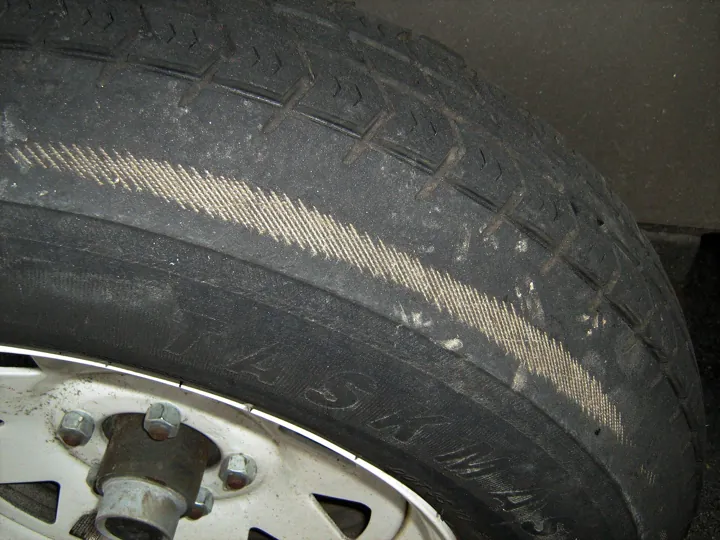
- Description
- Un pneu dont le flanc est usé jusqu'aux fibres après avoir roulé sous-gonflé.
- Source
- Christopher Ziemnowicz (CZmarlin) · original page
- Licence
- PD Public domain
 Self-serving bias
When it works, it is thanks to us; when it breaks, it is the fault of the context, the client or the team next door.
In brief
- What: successes are explained by one's own qualities, failures by external causes.
- Why: to protect self-esteem and one's image in front of others; we also look for fewer explanations when the result pleases us.
- Spotting it: a post-mortem whose list of causes contains only external factors, or “we” for success and “they” for failure.
- Avoiding it: describe the facts before the causes, look for internal and external causes in both cases, have a third party review.
Definition#
Self-serving bias is the tendency to take credit for one's successes (talent, effort, good decisions) and to shift responsibility for one's failures onto external factors (bad luck, circumstances, other people). It is an asymmetry: the same person, faced with the opposite outcome, changes explanation.
The reference article is by Dale Miller and Michael Ross (1975), “Self-serving biases in the attribution of causality: Fact or fiction?”. It poses a question that has remained famous: is the asymmetry motivated (we want to feel good) or cognitive (we expect to succeed, so we explain failure as an accident)? The debate has continued, and both mechanisms are now considered to be present.
It differs from the fundamental attribution error, which concerns how we explain the behavior of others: here, it is the explanation of one's own results that is distorted.
The mechanism#
- Protecting self-esteem. Admitting a mistake is uncomfortable; an external cause leaves one's image intact.
- Managing one's image. In front of a committee, a client or a manager, we explain things so as to present ourselves in an acceptable light, sometimes without realizing it.
- Information asymmetry. We know our own efforts, constraints and good intentions from the inside; we only see the results of others. The unfavorable circumstances we endured are vivid in memory, while those that helped are forgotten.
- Expectations. If we expected to succeed, a failure is judged “abnormal” and therefore looks for a cause outside ourselves.
A meta-analysis by Mezulis and colleagues (2004), covering more than two hundred studies, concludes that the asymmetry is very widespread among adults and children. It is, however, weaker in certain Asian cultures and among depressed people. Zuckerman (1979) answered Miller and Ross by showing that the motivational mechanism remains at work even when expectations are controlled. Finally, studies of letters to shareholders (Bettman and Weitz, 1983; Staw, McKechnie and Puffer, 1983) show that executives tend to explain good results by their decisions and bad ones by the economic environment.
Who explains what? Typical pattern, illustrative
Loading the chart…
View the data
| Internal causes (us, our choices) | External causes (context, others) | |
|---|---|---|
| After a success | 75 | 25 |
| After a failure | 30 | 70 |
Where it shows up#
In project management#
- Post-mortem and lessons learned: the list of causes of a delay contains the client, the vendors, the “unforeseen complexity”, almost never the initial estimate or the team's own choices.
- Production incident: “the change was correct, it's the environment”; when the incident comes from the neighboring team, it is “symptomatic of a lack of rigor”.
- Relations with a vendor or a client: each attributes the slippage to the other (see the case below). The contract becomes a defensive tool.
- Sprint review: goals that are met are met “thanks to the team”, goals that are missed are missed because of “dependencies” and “interruptions”.
In management#
- Annual self-assessment: results achieved are presented as personal accomplishments; missed objectives, as consequences of a context (reorganization, budget, tools).
- Executive decisions: a good year is an effect of the strategy; a bad one is an effect of the market.
- Feedback to staff: a manager who takes credit for the team's success and blames the team for its failures turns the same bias into a habit, which they then attribute to others.
Famous cases#
Ford and Firestone: each blames the other 2000-2001#
Bias at play: self-serving bias (mutual attribution of failure to the other), with defense of reputation.
What happened. Starting in 1999, Ford Explorer accidents show tire blowouts and tread separations. In August 2000, Bridgestone/Firestone recalls 6.5 million tires. Public debate quickly turns to the cause: Ford emphasizes the failure of the tires; Firestone maintains that the problem comes partly from the vehicle, its stability and the inflation pressure recommended by Ford. In May 2001, John Lampe, president of Bridgestone/Firestone, writes to Jacques Nasser, Ford's chief executive, that he can no longer supply him with tires, stating that, according to his analyses, there are “significant safety concerns” about some of the Explorers. Ford announces the same day the replacement of several million additional tires and claims it is a tire matter.
What this illustrates
Investigations and hearings implicated both the design and manufacture of the tires and elements specific to the vehicle: each of the two had a share of the problem. Yet each presented the other's share as the cause. The example is useful for a specific reason: it shows that the bias also affects organizations, that this asymmetry cannot be settled by asking each party to analyze itself alone, and that a third party (here the regulator, Congress, the courts) is often necessary. In your projects, client / vendor relationships follow the same pattern.
Letters to shareholders 1983#
Bias at play: self-serving bias in official communications.
Barry Staw, Pamela McKechnie and Sheila Puffer (1983) analyzed the shareholder letters of American companies, separating those announcing good results from those announcing bad ones. Their conclusion is that good results are attributed to internal causes (strategy, decisions, management) and bad ones to external causes (economic conditions, competition, regulations). Bettman and Weitz (1983) reach a similar finding on the annual reports of another set of companies.
What this illustrates
These letters are written to be read: what is explained in them is also explained in order to polish the image. An activity report, a project review or a sprint review is subject to the same temptation. Remember that the reader of a report must ask who wrote it, and what its author gains from one explanation rather than another.
Warning signs#
- An incident analysis that cites no internal cause, or no external cause for a success.
- “We” for what worked, “they” or “the context” for what didn't.
- Causes that are unverifiable (“the client didn't know what they wanted”) with no dated fact or document.
- Post-mortems where nobody has anything to change in their own practice.
- The same type of incident coming back, each time explained by a new external circumstance.
- Two teams or two organizations whose reports on the same event contradict each other, each exonerating itself.
Avoidance reflexes#
- Facts first, causes second. Start the lessons-learned session with a dated, neutral timeline, with no judgmental verbs. Causes come afterward.
- Two columns, in both cases. After a success as after a failure, list what was down to us (decisions, choices, avoidable mistakes) and what was down to the context (luck, help, circumstances).
- Look for what we could have done differently. “What, within our own scope, would we change next time?” is the question to ask before discussing external factors.
- Go beyond the first cause. The five whys method forces you past “the client changed their mind”: why hadn't we anticipated this change? Why didn't the process absorb it?
- A third party to facilitate. The post-mortem is led by someone with no stake in the result, and it adopts a blameless framework so that acknowledging a mistake costs nothing.
- Lead by example. The manager or sponsor names their own share first (late decision, questionable trade-off): this makes the gesture normal.
- Verify each external cause. For each one: what fact proves it, and what action on our part could have limited its effect?
With AI: detect, remedy, mitigate#
AI reads a text with no personal stake well: it can count the internal and external causes of a report, and rephrase as facts what is stated as blame. It cannot, however, verify the facts or know what really happened; and if given an already slanted account, it will take it on as is.
Detect#
- Classify the causes cited in a report as internal or external, and point out the imbalance.
- Spot the pronouns and phrasings that attribute (“we succeeded”, “they were late”).
- Compare two reports of the same event, written by different parties.
Fix#
- Turn a narrative into a factual timeline, without judgment.
- Suggest the plausible internal causes to examine, based on the facts given.
- Draft the questions for a blameless post-mortem.
Mitigate#
- Have AI review a lessons-learned report before it is circulated, as a second opinion.
- Ask it to argue for the other party to obtain their account.
- Use a report template that requires both columns of causes.
Prompts to build into your practice#
1. Tally of internal and external causes. On a post-mortem report, anonymized.
Here is the report of a project or an incident (names removed). Make two lists:
1. the causes the text attributes to the team or its work (internal);
2. the causes it attributes to the context, the client, other teams or bad luck (external).
Then indicate, for each external cause, the cited fact that supports it, or the absence of a fact.
Conclude with a sentence on the balance between the two lists, without blaming anyone.

Report: [text]
2. Factual timeline, then questions. To prepare a blameless lessons-learned session.
Here are the raw notes of an incident or a delay. Rewrite them as a dated, neutral timeline: observable facts only, with no adjectives or judgments, and flagging what is an interpretation.
Then propose ten open questions for the lessons-learned session, of the form “how”, “what made it possible”, “what would we change within our scope”, without the question “who”.
Do not conclude on the cause: just list the leads to verify.

Notes: [text]
How to build them in#
- Before the meeting: each participant sends their notes to prompt 2, rereads the timeline and corrects the facts.
- After drafting: prompt 1 serves as a balance check, before the report is circulated.
- Keep the decision in human hands: the tool proposes a classification, the group decides what is true.
Precautions#
- AI does not establish facts: it reorganizes what it is given. Do not use it to point to a culprit.
- An already slanted account will slant the answer: give the raw notes, not your interpretation.
- Do not paste personal data, employee names or confidential information into an unauthorized tool.
Limits#
- The bias is not universal: it varies with culture, mood, personality and social context (in front of an audience, people appear more modest or more defensive).
- Attributing a failure to external causes is not always wrong: the context exists, and sometimes the fault really does lie elsewhere. The bias lies in the systematic asymmetry, not in an isolated explanation.
- Part of the asymmetry is cognitive (expectations, available information) and not defensive; it is therefore not bad faith.
- Taking all the responsibility for every failure is also a bias, and does not help learning either.
Sources and verification#
- Miller & Ross (1975), “Self-serving biases in the attribution of causality: Fact or fiction?”, Psychological Bulletin, 82(2)
- Zuckerman (1979), “Attribution of success and failure revisited, or: The motivational bias is alive and well in attribution theory”, Journal of Personality, 47(2)
- Mezulis, Abramson, Hyde & Hankin (2004), “Is there a universal positivity bias in attributions? A meta-analytic review…”, Psychological Bulletin, 130(5)
- Staw, McKechnie & Puffer (1983), “The justification of organizational performance”, Administrative Science Quarterly, 28(4)
- Bettman & Weitz (1983), “Attributions in the board room: Causal reasoning in corporate annual reports”, Administrative Science Quarterly, 28(2).
- Modern Tire Dealer, “Firestone/Ford partnership ends acrimoniously” (May 21, 2001) — letter from J. Lampe, reciprocal accusations.
- Modern Tire Dealer, “Ford continues to blame Firestone tires as it prepares for its own recall” (May 21, 2001) — tire replacement, 174 deaths and over 6,000 reports.
- EBSCO Research Starters, “Bridgestone/Firestone Announces Massive Recall” — recall of August 9, 2000.
See also#
Related biases#
Variants or cousins: not to be confused.
Counterweights and related reflexes#
What neutralises it.
- Le post-mortem sans recherche de coupable (concept or method, no page)
- Les cinq pourquoi (concept or method, no page)
- Le regard d'un tiers (concept or method, no page)
- The devil's advocate
