

- Description
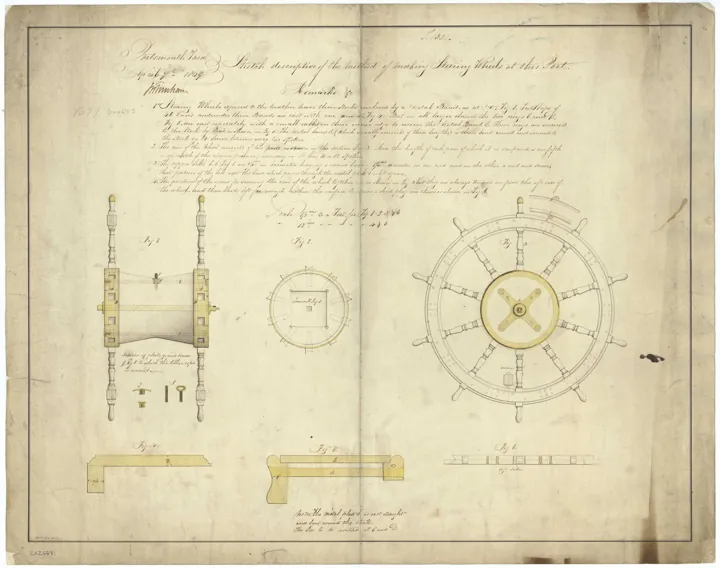
- Plan ancien d'une roue de gouvernail de navire, en élévation de face et de côté.
- Source
- auteur non indiqué · original page
- Licence
- PD Public domain
 Governance and Steering (GOU)
Governance answers two questions: who decides what, and based on what information? When it's absent, decisions are made by default (the loudest voice wins) or not made…
Level: 🟢→🔴 · Code: GOU · Matrix: PI
Why this topic#
Governance answers two questions: who decides what, and based on what information? When it's absent, decisions are made by default (the loudest voice wins) or not made at all (issues drag on). When it's excessive, committees produce presentations and teams wait. The challenge is the speed of making the right decision: a gap detected on Tuesday must be arbitrated before Friday, at the level that has both the authority and the information.
What this topic measures#
- Axis: from implicit decision-making to proportionate governance based on reliable data.
- Key indicator: time between detecting a gap (delay, overrun, blockage) and the corrective decision; reliability of reported status (gap between “green” status and reality).
- Unit: days of decision latency; percentage of verified statuses found compliant.
The five levels#
| Level | Short name | Promise | Typical indicator (order of magnitude) |
|---|---|---|---|
| 1 | As it goes | Decisions are made when someone insists; project status is discovered by asking for it. | Decision latency: weeks; status known by 1 or 2 people |
| 2 | Regular monitoring | A recurring meeting provides project status; decisions are tracked. | Review at least monthly; minutes within 48 hrs |
| 3 | Defined governance bodies | Everyone knows who decides what and when to escalate; steering information comes from shared sources. | Escalation latency < 1 week; written alert thresholds |
| 4 | Data-driven steering | Gaps are detected through reliable indicators and handled in under a week; “green” status is trustworthy. | Status/reality gap < 10%; decision in < 5 business days |
| 5 | Adaptive governance | Governance is lightened when risk decreases and strengthened when it rises; it accelerates the project instead of slowing it down. | Governance overhead < 5 to 10% of team time, measured |
Milestones by level#
| ID | Milestone | Verifiable evidence |
|---|---|---|
| PI-GOU-1.1 | A project owner is identifiable. | Their name is known by the first 3 people asked. |
| PI-GOU-1.2 | Important decisions leave a trace (email, ticket). | Find the decision for a recent change. |
| PI-GOU-1.3 | Progress status can be requested and obtained. | Request status: response within 2 days. |
| PI-GOU-2.1 | A recurring review (weekly or biweekly) takes place with an agenda. | Calendars and minutes from the last 3 months. |
| PI-GOU-2.2 | A decision log (date, decision, decision-maker) is maintained. | File or page with at least one entry per month. |
| PI-GOU-2.3 | A single tracking dashboard (progress, open items) exists. | A single up-to-date reference document. |
| PI-GOU-3.1 | Roles and decision rights are documented (sponsor, product/project owner, team, committee). | Up-to-date responsibility matrix. |
| PI-GOU-3.2 | Escalation thresholds are defined (schedule, cost, risk variance) with an escalation path. | Threshold document; example of a real escalation. |
| PI-GOU-3.3 | Steering indicators are defined (written definitions) and fed by the tracking tool. | Definitions + extraction from the tool, not retyped. |
| PI-GOU-3.4 | Committees have a purpose, required participants, and a bounded duration. | Standard agenda; duration ≤ 1 hr. |
| PI-GOU-4.1 | Key indicators are reliable: a sample audit finds no falsified status. | Sample of 5 items verified against the field. |
| PI-GOU-4.2 | Automatic or visual alerts flag gaps before the meeting. | Dashboard with thresholds and colors; alert history. |
| PI-GOU-4.3 | The gap → decision time is measured and under 5 business days. | Series of 10 gaps with detection and decision dates. |
| PI-GOU-4.4 | Corrective decisions are tracked until impact is observed. | Review of 5 decisions: impact verified or closed. |
| PI-GOU-5.1 | Governance level is adjusted to project risk (small/medium/large). | Three governance formats in use. |
| PI-GOU-5.2 | The cost of governance (time spent) is measured and reduced when it exceeds value. | Meeting and reporting hours per project. |
| PI-GOU-5.3 | Decisions are delegated to the team as long as risk remains within tolerance. | List of delegated decisions; few unnecessary escalations. |
| PI-GOU-5.4 | Governance is reviewed annually based on its outcomes. | Documented governance retrospective. |
Detailed reading by level#
Level 1. Signs: “who decides?” remains without a clear answer; status is reconstructed before each steering meeting. Benefit: agility of a small group. Does not guarantee: consistency or decision memory. Difficulty: 1/5. Effort: 1/5.
Level 2. Signs: a fixed tracking meeting, minutes. Benefit: minimum visibility, less repetition. Does not guarantee: that decisions are made at the right level or that information is reliable. Difficulty: 2/5. Effort: 1/5.
Level 3. Signs: it's clear when an issue merits escalation and to whom; indicators have a shared definition. Benefit: management decides based on facts, the team is not interrupted for everything. Does not guarantee that indicators are honest. Difficulty: 3/5. Effort: 2/5.
Level 4. Signs: the dashboard alerts before the meeting; there are figures for status/reality gaps. Benefit: early correction, therefore cost-effective. Does not guarantee the relevance of chosen indicators (see pitfall). Difficulty: 4/5. Effort: 3/5.
Level 5. Signs: three governance formats based on risk; teams decide within their tolerance. Benefit: speed without loss of control. Does not guarantee strategy. Difficulty: 5/5. Effort: 4/5.
Partial achievement and rating#
Common rule: see README.
- 0.5: governance body exists but is never used to decide (recording committee); indicators entered manually before each meeting.
- 1: a sample of decisions and statuses proves it.
- A partial 5: level 4 achieved on large projects, three governance formats used, but governance cost not measured (5.2 = 0). Score: around 4.3.
SFA/datamart product team: weekly review, decision log, escalation thresholds (level 3 achieved). The dashboard is fed from Azure DevOps Server but the “green” status of a package has never been checked against the actual status of open defects: 4.1 = 0.5. Score ≈ 3.4.
Move to the next level#
Possible means (optional)
- 1 → 2: weekly 30-minute meeting, a single tracking dashboard, a one-line decision log per decision.
- 2 → 3: RACI matrix (or lighter equivalent), escalation thresholds, indicator definitions; see Project Management Fundamentals and Project Metrics and Reporting.
- 3 → 4: automatic extraction from the tool (work item queries, Azure DevOps Server (ex-TFS) in Depth), sample audit, alerts.
- 4 → 5: governance templates by size, measurement of time spent, formalized delegation.
Watermelon reporting: all green on the outside, red on the inside. Symptom: gaps appear very late. Cause: status is an opinion, and the incentive is not to bother others. Remedy: indicators calculated from the tool (not self-reported), right to make mistakes, sample audit (PI-GOU-4.1).
Goodhart's law: if “zero variance” is rewarded, teams redefine deadlines so they are never late. Monitor rebaselines (number of replans per project).
Write the decision right before defining the committee: a committee without authority is an audience.
An assistant can produce minutes, detect gaps between reported status and tickets, prepare the agenda; see AI in Service of Project Management (General Then Data). It does not decide, and an automatic status summary can itself hide a gap if the input is biased.
See also#
- Related topics: 01 Scoping and Vision · 03 Planning and Estimation · 05 Risk Management · 07 Stakeholders and Communication · 11 Budget, Value, and Benefits.
- Other matrices: Data Governance and Organization (data) · Governance, Catalog, and Self-Service (BI).
- Practice: Project Management Fundamentals · Scrum, the framework (Scrum Guide 2020) · Comparison of Project Management Methods · Project Metrics and Reporting · Glossary.
✻ Written by Claude Sonnet 5.5
