

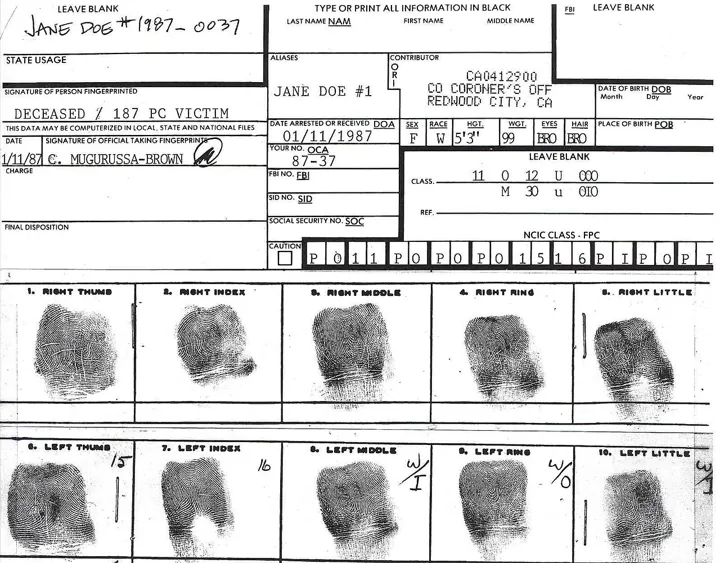
- Description
- A fingerprint card
- Source
- Daly City, CA Medical Examiner · original page
- Licence
- PD Public domain
 Confirmation bias
Once we have an explanation, we stop trying to test it: we look for reasons why we were right.
In brief
- What: we seek, interpret, and remember information in ways that reinforce what we already believe.
- Why: testing an idea through its successes takes less effort and hurts less than putting it at risk.
- Detect: all planned tests could succeed; contradictory data are “special cases.”
- Avoid: look for the test that would refute the hypothesis, write in advance what would make you abandon it, have a third party challenge it.
Definition#
 Fictitious illustration
Confirmation bias is the tendency to seek, interpret, favor, and remember information that confirms an existing belief or hypothesis, while treating information that contradicts it more lightly. British psychologist Peter Wason gave the classic experimental demonstration in 1960; the term actually covers several mechanisms (see below), which Nickerson's synthesis (1998) clearly highlighted.
It's not bad faith: the person sincerely believes they are seeking the truth. The bias acts on where they look, on what they count as evidence, and on what they retain.
The mechanism#
Three layers, which build on each other:
- Biased search. We choose tests, questions, and sources that are most likely to prove us right. Klayman and Ha (1987) show that this “positive test” is often a reasonable strategy; it becomes a pitfall when it is the only strategy, because a test that cannot fail teaches nothing.
- Biased interpretation. The same fact is judged solid if it supports our view, questionable if it contradicts it. In the study by Lord, Ross, and Lepper (1979), students for or against the death penalty read the same two studies, one in each direction: each group judged the study aligned with its opinion as more convincing, and came away more certain than before.
- Biased memory. We remember confirming cases better than disconfirming ones.
Participants are told that the sequence 2, 4, 6 follows a rule, which they must guess by proposing other sequences; each time, the experimenter says “yes” or “no.” The real rule is very broad: three strictly increasing numbers. Many imagine “+2 each time” and propose only sequences that confirm it (8, 10, 12; 20, 22, 24), get “yes” answers, and confidently announce their rule—wrongly. Those who succeed propose sequences that should be rejected if their idea is correct (for example 1, 2, 3 or 5, 4, 3). Wason saw this as a failure to seek counterexamples.
The translation to software is immediate: testing a fix on the case that just crashed only proves it fixes that case. Useful information comes from the test that could have failed.
Validation tests for a fix (illustrative)
Loading the chart…
View the data
| Tests that can only confirm | Tests that could refute | |
|---|---|---|
| Tests run | 24 | 3 |
Where you encounter it#
In project management#
- Bug diagnosis: we're convinced the network is at fault; we look in logs for timeout errors and ignore lines that don't match. We “verify” the fix by replaying only the scenario that crashed.
- Technical choices: the team that already chose the technology gathers benchmarks, articles, and testimonials that validate it; warnings are read in order to refute them.
- Code reviews and acceptance testing: the reviewer who knows the author is reliable looks less; the tester who knows what the app “should do” runs the nominal scenario.
- Data analysis: we try different splits until we find one that shows the expected effect, then stop.
- Retrospectives: the “obvious” cause is accepted by day two, and the investigation is used to document it (see also Hindsight bias).
In management#
- Judgment about a person: once it's “this person is weak,” every delay confirms it and every success is attributed to luck or someone else's help. The reverse applies for the “brilliant” person (see The halo effect).
- Recruiting: the interview becomes a search for evidence of the first impression, through closed questions that call for the expected answer.
- Already-made decisions: the selected indicators are the ones showing that the reorganization “is working.”
- Information received: we stick to channels and colleagues who think like us, and the feedback we get merely reflects the initial idea.
The choice of measures and filters in a report may keep only what confirms the hypothesis: we keep the measure that goes up. Write the hypothesis and its refutation criterion before building the DAX measure, then have the definition reviewed by someone who doesn't believe in it.
Famous cases#
The Madrid fingerprint and Brandon Mayfield March-May 2004; report 2006#
Biases at play: confirmation, expert authority, overconfidence.
What happened. After the bombings, Spanish police sent the FBI a partial fingerprint recovered from a bag of detonators. A search in the FBI database returned several candidates, including Brandon Mayfield. An FBI expert concluded there was a definite match, confirmed by two other examiners, then by an outside expert; Spanish police, however, had doubts as early as April. Mayfield was arrested on May 6, 2004, then released two weeks later when Spanish authorities established that the print belonged to another man. In 2006, the Department of Justice's Office of the Inspector General published a report on the case: it noted in particular that once the presumed match was established, examiners found more and more “matching points,” and that objections from their Spanish counterparts were dismissed rather than examined.
What this illustrates
An early conclusion steers the review of everything that follows: the expert who “sees” the match ends up seeing more of it, and peer review by people informed of the conclusion confirms instead of checking. Hence the reflex to adopt in projects: a review that knows the author's conclusion is not an independent assessment. Real verification is blind, by someone whose task is to look for the error.
Wason and the 2-4-6 rule 1960#
Biases at play: confirmation, positive test.
In 1960, Peter Wason published in the Quarterly Journal of Experimental Psychology the experiment described above. What made it famous was not the number, but the behavior: students, getting “yes” responses to their own proposals, confidently announced rules narrower than the real rule, without ever testing a sequence that would have refuted them. The precise results (number of participants, success rate) can be found in the article.
What this illustrates
A test that cannot fail is not evidence. Before launching an acceptance testing campaign or choosing a validation dataset, the useful question is: “what result would make me change my mind?” If the answer is “none,” the test only confirms the starting idea.
Elf's “sniffer planes” (France) 1976-1979; revealed in 1983#
Bias at play: confirmation bias (with wishful thinking).
What happened. Two inventors claimed they could detect oil fields from an airplane thousands of meters underground; the state-owned oil group Elf funded them for three years for hundreds of millions of francs. The process was a hoax. Demonstrations were conducted over sites already known to Elf, with a device kept secret: favorable tests were retained as proof, doubts dismissed. In May 1979, physicist Jules Horowitz showed that a ruler placed behind a screen appeared unchanged in the image even though it had been altered: the device “saw” nothing.
The full account, with sources and limitations, is in the Wishful thinking page.
What this illustrates
Evidence is only evidence if it could have failed: have test cases chosen by a third party who does not know the expected answer.
Detection signals#
- “I knew it, look, this confirms it”: every new piece of information is read as one more argument.
- No participant can say what would prove we're wrong.
- Counterexamples are met with “it's a special case,” “it's a false positive,” “it doesn't count.”
- All consulted sources share the same view (same team, same publisher, same discussion thread).
- The search stops as soon as the first plausible explanation is found.
- The standard of proof changes depending on direction: strict protocol is required for unfavorable data, while an anecdote is enough for favorable data.
Avoidance reflexes#
- Write in advance what would make you abandon the hypothesis. “If the fix is good, test X should no longer fail; if it still fails, then we're targeting the wrong cause.” The criterion must be set before looking at the results.
- Look for the test that can fail. For a given hypothesis, choose the experiment where it is most exposed, not the one where it shines.
- Keep multiple hypotheses alive. At least two rival explanations, written on the board, until one is eliminated by a fact.
- Ask for the opposite. “What data would we have if that were not true?”; “what would an honest detractor cite?”. See also devil's advocate and pre-mortem.
- Have it checked blind. The reviewer does not know the author's conclusion, or is tasked with contradicting it. This is not cynicism: it's the condition for a review to add something.
- Separate observation from interpretation. First record the raw facts (logs, measurements), then the interpretation, and only then the decision.
- Decide criteria before data: success indicators for a reorganization, decision threshold for a technical choice, scope breakdown of an analysis.
- Actively seek opposing views: read the best-argued critique of the selected solution, or ask for it from someone who did not choose it.
With AI: detect, fix, mitigate#
A language model can tirelessly play the devil's advocate and draft refuting tests. But it also tends to agree with the interlocutor (complacency, “sycophancy”): if you present your hypothesis as likely, it will support it. Its usefulness depends on how the question is asked.
Detect#
- Review an incident analysis or decision file and list the elements that do not support the conclusion, then those that were dismissed.
- Identify immunizing wording (“special case,” “doesn't count”).
- Check whether all planned tests can succeed.
Fix#
- Propose rival hypotheses and for each one the test that would distinguish it.
- Draft refuting tests (edge cases, unexpected inputs) for a fix.
- Build the opposing case against a decision already made.
Mitigate#
- Submit the question without saying what you think, or by proposing multiple possible answers.
- Ask for two opposing arguments of equal strength, to compare.
- Have it reviewed by a second model or a second session that does not know the conclusion.
Prompts to integrate into your practices#
1. Rival hypotheses and discriminating test. At the beginning of a diagnosis, before committing to a cause.
Here is an observed symptom: [factual description, without interpretation].
Do not try to validate one cause. Propose five possible explanations, including unlikely ones, from most likely to least likely.
For each, provide: (1) a test that would distinguish it from the others and could refute it, (2) what would be observed if it were false.
Finish by indicating which factual elements are missing to decide.
2. Devil's advocate on a conclusion. When a cause or choice seems settled and you want to test it.
Our team concludes that: [conclusion]. The elements it is based on: [list of facts].
Your role is to contradict, not to nuance: give the three best reasons why this conclusion could be false, the facts in the list that could be interpreted differently, and the data we did not look for.
Then write the most dangerous test for our conclusion. Do not invent references.
How to integrate them#
- Before testing: prompt 1 defines the hypothesis space; the refutation criterion is written before launching any test.
- Before deciding: prompt 2 serves as lightweight counter-review, in addition to (not instead of) outside human judgment.
- In review: rerun prompt 2 on the final report to see what a skeptical reader would criticize.
Precautions#
- Do not phrase your conclusion in the prompt: “confirm that the cache is the cause” will produce confirmation.
- A fluent counterargument is not evidence: it provides leads to check, not facts.
- Cited references may be invented: verify them.
- Do not send logs or data containing personal or confidential information to an unauthorized tool.
Limits#
- Seeking confirmation is not always an error. Klayman and Ha (1987) remind us that testing a case where one expects to find the property is often effective, especially when it is rare. Bias begins when that is the only strategy.
- The term covers distinct phenomena (search, interpretation, memory) whose magnitude varies; the Wason task itself is debated: it measures both rule difficulty and preference for confirmation.
- Experience and expertise do not protect against it: they can even make after-the-fact explanations easier to construct.
- Requiring a refuting test for everything is costly: reserve the exercise for important decisions or decisions that are hard to reverse.
Sources and verification#
- Wason (1960), “On the failure to eliminate hypotheses in a conceptual task,” Quarterly Journal of Experimental Psychology 12(3) — the 2-4-6 task.
- Nickerson (1998), “Confirmation bias: A ubiquitous phenomenon in many guises,” Review of General Psychology 2(2) — synthesis.
- Klayman & Ha (1987), “Confirmation, disconfirmation, and information in hypothesis testing,” Psychological Review 94(2)
- Lord, Ross & Lepper (1979), “Biased assimilation and attitude polarization: The effects of prior theories on subsequently considered evidence,” Journal of Personality and Social Psychology 37(11)
- U.S. Department of Justice, Office of the Inspector General (2006), A Review of the FBI's Handling of the Brandon Mayfield Case — public report on the Madrid fingerprint case; consult for detailed findings.
